


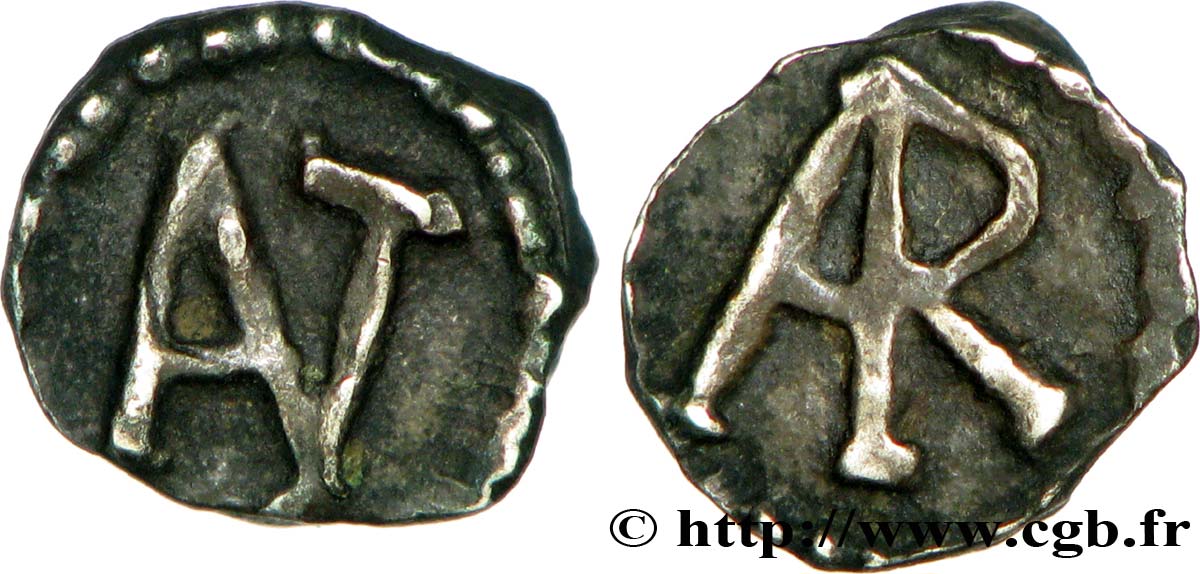
v38_1692 - MONETE DELLO MEROVINGI - MARSEILLES (MASSILIA) o ARLES ( ARELATUM) Denier, patrice Antenor
MONNAIES 38 (2009)
起拍价 : 380.00 €
估价 : 600.00 €
竞价记录 : 506.00 €
出价数量 : 6
最高出价 : 550.00 €
起拍价 : 380.00 €
估价 : 600.00 €
竞价记录 : 506.00 €
出价数量 : 6
最高出价 : 550.00 €
种类 Denier, patrice Antenor
日期: c. 700-726
铸币厂名称/城市 ARLES ou MARSEILLE
材质 silver
直径 9,5 mm
模子方针 9 h.
重量 0,94 g.
稀少度 R3
关于品相的说明
Superbe petit denier frappé sur un flan très court et épais. Droit et revers complet avec une patine sombre dans les champs, mais plus brillante sur les reliefs des lettres et des grènetis
出版目录中的项代码 :
正面
正面的说明书 Monogramme ANT dans un grènetis.
背面
背面的说明书 Monogramme AR dans un grènetis.
评论
Cet exemplaire correspond exactement au n° 119 du catalogue du Trésor de Nice-Cimiez (cf. n° 109 page 29 ; 27 exemplaires).
Les deux monnaies B. 290 et 291 ont donné lieu à bien des interprétation diverses. Fillon les a attribuées à Antérieux, Ain (?). D’Amécourt, combinant les deux monogrammes [de la B. 291] y a vu le nom de Darantisia. Morel-Fatio y voit le monogramme d’Anténor et les attribue à Marseille. M. Laugier, admettant le monogramme d’Anténor, ne les accepte cependant pas pour l’atelier de Marseille. Son opinion est que ces monnaies ont été frappées par Anténor, à Arles. Cette ville a en effet porté les noms d’Arelatum et d’Aredis, qui seraient représentés par les monogrammes de l’avers. Les monogrammes du revers appartiendraient à Anténor. En présence de ces opinions diverses, A. de Belfort attribuait dubitativement ces monnaies à Arelatum. Cf. Belfort tome I, page 87.
Selon Wikipedia, “non soumis aux Pippinides, Antenor représente les Mérovingiens en Provence à une époque où l'autorité de ceux-ci est contestée par les maires du Palais. On a pris argument des frappes monétaires [1] faites au nom des patrices pour montrer l'indépendance prise en Provence par rapport au pouvoir franc. Mais ces monnaies, des deniers d'argent, sont toutefois marquées de son monogramme”.
Antenor serait patrice de Provence vers les années 700-716 alors que G. Depeyrot classe ce denier à un certain Antenor II, patrice vers 715-726 (?).
This example corresponds exactly to no. 119 of the Nice-Cimiez Treasury catalogue (cf.. No. 109 page 29; 27 copies).
The two coins B. 290 and 291 have given rise to many different interpretations. Fillon attributed them to Antérieux, Ain (?). D'Amécourt, combining the two monograms [of the B. 291] saw the name Darantisia there. Morel-Fatio sees the monogram of Anténor and attributes them to Marseille. M. Laugier, admitting the Anténor monogram, does not however accept them for the Marseille workshop. His opinion is that these coins were minted by Antenor, in Arles. This city in fact bore the names of Arelatum and Aredis, which would be represented by the monograms on the obverse. The monograms on the reverse are said to belong to Anténor. In the presence of these diverse opinions, A. Belfort doubtfully attributed these coins to Arelatum. Cf. Belfort volume I, page 87.
According to Wikipedia, “not subject to the Pippinides, Antenor represents the Merovingians in Provence at a time when their authority was contested by the mayors of the Palace. The argument of the monetary strikes [1] made in the name of the patricians was taken to show the independence taken in Provence from the Frankish power. But these coins, silver denarii, are nevertheless marked with his monogram.”.
Antenor would be patrician of Provence around the years 700-716 while G. Depeyrot classifies this coin to a certain Antenor II, patrician around 715-726 (?)
Les deux monnaies B. 290 et 291 ont donné lieu à bien des interprétation diverses. Fillon les a attribuées à Antérieux, Ain (?). D’Amécourt, combinant les deux monogrammes [de la B. 291] y a vu le nom de Darantisia. Morel-Fatio y voit le monogramme d’Anténor et les attribue à Marseille. M. Laugier, admettant le monogramme d’Anténor, ne les accepte cependant pas pour l’atelier de Marseille. Son opinion est que ces monnaies ont été frappées par Anténor, à Arles. Cette ville a en effet porté les noms d’Arelatum et d’Aredis, qui seraient représentés par les monogrammes de l’avers. Les monogrammes du revers appartiendraient à Anténor. En présence de ces opinions diverses, A. de Belfort attribuait dubitativement ces monnaies à Arelatum. Cf. Belfort tome I, page 87.
Selon Wikipedia, “non soumis aux Pippinides, Antenor représente les Mérovingiens en Provence à une époque où l'autorité de ceux-ci est contestée par les maires du Palais. On a pris argument des frappes monétaires [1] faites au nom des patrices pour montrer l'indépendance prise en Provence par rapport au pouvoir franc. Mais ces monnaies, des deniers d'argent, sont toutefois marquées de son monogramme”.
Antenor serait patrice de Provence vers les années 700-716 alors que G. Depeyrot classe ce denier à un certain Antenor II, patrice vers 715-726 (?).
This example corresponds exactly to no. 119 of the Nice-Cimiez Treasury catalogue (cf.. No. 109 page 29; 27 copies).
The two coins B. 290 and 291 have given rise to many different interpretations. Fillon attributed them to Antérieux, Ain (?). D'Amécourt, combining the two monograms [of the B. 291] saw the name Darantisia there. Morel-Fatio sees the monogram of Anténor and attributes them to Marseille. M. Laugier, admitting the Anténor monogram, does not however accept them for the Marseille workshop. His opinion is that these coins were minted by Antenor, in Arles. This city in fact bore the names of Arelatum and Aredis, which would be represented by the monograms on the obverse. The monograms on the reverse are said to belong to Anténor. In the presence of these diverse opinions, A. Belfort doubtfully attributed these coins to Arelatum. Cf. Belfort volume I, page 87.
According to Wikipedia, “not subject to the Pippinides, Antenor represents the Merovingians in Provence at a time when their authority was contested by the mayors of the Palace. The argument of the monetary strikes [1] made in the name of the patricians was taken to show the independence taken in Provence from the Frankish power. But these coins, silver denarii, are nevertheless marked with his monogram.”.
Antenor would be patrician of Provence around the years 700-716 while G. Depeyrot classifies this coin to a certain Antenor II, patrician around 715-726 (?)
历史细节
MEROVINGIAN COINAGE - ARLES (ARELATVM) or MARSEILLE (MASSILIA)
(7th - 8th century)
Childeric II abolishes the minting of gold in Gaul in favor of silver coinage. The Marseilles mint struck silver coins after the assassination of Childeric II in 675 and probably until the beginning of the reign of Pepin the Short. The workshop had an important production of which the only treasure of Nice-Cimiez delivered a great variety of types. Five patricians succeeded one another at the head of the city, Ansedertus, Nemfidius, Antenor, Metranus and Abbo. In 736, Provence was attached to the kingdom of France and Charles Martel put an end to the patriciate. No copper production in Marseilles seems attested. For lack of text, the dates of these patrices are not known.
 对产品描述纠错
 打印
打印 分享我的选择
 提问
提问 Consign / sell
Your Recently Viewed Items
100 Francs CORNEILLE FRANCE 1976 F.65.54 AU-
40.00 €
IRELAND REPUBLIC 2 Euro 10 ANS DES PIÈCES ET BILLETS EN EUROS 2012 MS
3.00 €
LUXEMBOURG 2 x 2 Euro NAISSANCE DU PRINCE CHARLES - Version Classique et Hologra
14.00 €
FRANCE 1 Euro de Reims (16 - 27 mai 1998) 1998 MS
5.00 €

FRANCE 10 Euro LE PETIT PRINCE AUX COURSES DE VOITURE 2016 MS
13.00 €

Belle Épreuve argent 5 francs Semeuse 2001 Paris F5.1206 2 MS
78.00 €
cgb.fr 集币


