


无库存.
所有在网站上销售的产品 (2013)
价格 : 220.00 €
所有在网站上销售的产品 (2013)
价格 : 220.00 €
种类 Tétradrachme syro-phénicien
日期: An 36 et 13e consulat
铸币厂名称/城市 Antioche, Syrie, Séleucie et Piérie
材质 silver
直径 25 mm
模子方针 12 h.
重量 13,24 g.
出版目录中的项代码 :
家谱
Cet exemplaire est le 0057_066 de la base TSP
正面
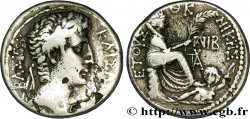
正面的说明书 Tête laurée d’Auguste à droite entouré de la stemma (O*).
正面铭文 KAISAROS SE-BASTOU (Kaisaros Sebastou)
正面的翻译 (César Auguste).
背面
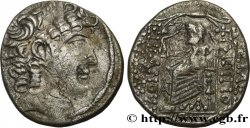
背面的说明书 Tyché (Ville d’Antioche) tourelée, voilée et drapée assise à droite sur un rocher, tenant une palme de la main droite ; à ses pieds à droite, l’Oronte nageant à droite.
背面铭文 ANTIOCEWN MHTROPOLEWS - sL - DN
背面的翻译 Antioche métropole / monogramme d’Antioche 36 - 54.
评论
Cette émission, qui s’étend de l’an 36 (6 AD) à la mort de l’Empereur, en l’an 44 du règne (14 AD) présente aussi un type religieux plus oecuménique que ceux qu’utilisèrent les Séleucides : la Tyché de la ville d’Antioche. On peut penser que l’Antioche de l’époque, probablement une ville de 150 à 200.000 habitants, était un creuset de cultes différents et que les Romains, plutôt que d’imposer un dieu particulier, choisirent une image dans laquelle tous les Antiochéens, voire tous les habitants de la région, pouvaient se reconnaître. La statue de la Tyché représentée au revers, était la statue cultuelle de l’artiste Eutychides, si célèbre que des copies d’époque nous en sont parvenues.
En revanche, cette variante se caractérise par une légende qui fait directement référence à la ville d’Antioche, appelée ici Métropole, titre essentiel dans la hiérarchie des villes grecques, et par une datation simultanée en années régnales, ici la trente-sixième année du règne et par l’année de l’ère césarienne (qui débute à sa première visite dans la région), ici cinquante-quatrième année.
Dans la base TSP maintenue par Michel Prieur, quatre-vingt dix-sept exemplaires, dont treize en musées ou en collections publiques (Paris, British Museum, deux exemplaires, Copenhague, Vienne, ANS, deux exemplaires,Berlin, trois exemplaires, Yale, Munich et le Money Museum de l’ANA) sont maintenant répertoriés.
This issue, which extends from the year 36 (6 AD) to the death of the Emperor, in the year 44 of the reign (14 AD) also presents a more ecumenical religious type than those used by the Seleucids: the Tyche of the city of Antioch. It is possible to think that Antioch at that time, probably a city of 150 to 200. 000 inhabitants, was a melting pot of different cults and that the Romans, rather than imposing a particular god, chose an image in which all the Antiochians, indeed all the inhabitants of the region, could recognize themselves. The statue of Tyche depicted on the reverse was the cult statue of the artist Eutychides, so famous that examples of it from the period have come down to us..
On the other hand, this variant is characterized by a legend that directly refers to the city of Antioch, called here Metropolis, an essential title in the hierarchy of Greek cities, and by a simultaneous dating in regnal years, here the thirty-sixth year of the reign and by the year of the Caesarean era (which begins with his first visit to the region), here the fifty-fourth year.
In the TSP database maintained by Michel Prieur, ninety-seven examples, including thirteen in museums or public collections (Paris, British Museum, two examples, Copenhagen, Vienna, ANS, two examples, Berlin, three examples, Yale, Munich and the Money Museum of the ANA) are now listed.
En revanche, cette variante se caractérise par une légende qui fait directement référence à la ville d’Antioche, appelée ici Métropole, titre essentiel dans la hiérarchie des villes grecques, et par une datation simultanée en années régnales, ici la trente-sixième année du règne et par l’année de l’ère césarienne (qui débute à sa première visite dans la région), ici cinquante-quatrième année.
Dans la base TSP maintenue par Michel Prieur, quatre-vingt dix-sept exemplaires, dont treize en musées ou en collections publiques (Paris, British Museum, deux exemplaires, Copenhague, Vienne, ANS, deux exemplaires,Berlin, trois exemplaires, Yale, Munich et le Money Museum de l’ANA) sont maintenant répertoriés.
This issue, which extends from the year 36 (6 AD) to the death of the Emperor, in the year 44 of the reign (14 AD) also presents a more ecumenical religious type than those used by the Seleucids: the Tyche of the city of Antioch. It is possible to think that Antioch at that time, probably a city of 150 to 200. 000 inhabitants, was a melting pot of different cults and that the Romans, rather than imposing a particular god, chose an image in which all the Antiochians, indeed all the inhabitants of the region, could recognize themselves. The statue of Tyche depicted on the reverse was the cult statue of the artist Eutychides, so famous that examples of it from the period have come down to us..
On the other hand, this variant is characterized by a legend that directly refers to the city of Antioch, called here Metropolis, an essential title in the hierarchy of Greek cities, and by a simultaneous dating in regnal years, here the thirty-sixth year of the reign and by the year of the Caesarean era (which begins with his first visit to the region), here the fifty-fourth year.
In the TSP database maintained by Michel Prieur, ninety-seven examples, including thirteen in museums or public collections (Paris, British Museum, two examples, Copenhagen, Vienna, ANS, two examples, Berlin, three examples, Yale, Munich and the Money Museum of the ANA) are now listed.
历史细节
AUGUSTUS
(01/16/27 BC - 08/19/14 AD)
Augustus, after Actium and the taking of Alexandria, remains the sole master of the Roman Empire. He gave his powers to the senate in 27 and was honored with the title of august, giving birth to a new political regime: the principate.. The next forty years will be devoted to structuring and consolidating the system put in place by Augustus on the political, economic and cultural level.. He is assisted by Agrippa, who becomes his son-in-law by marrying his daughter Julia in 21 BC.. -VS. and bears him two grandsons, Caius and Lucius. Unfortunately, Agrippa, friend and double, died in 12 BC.. -VS. On the military level, he is seconded first by Drusus then by Tiberius - the two sons of his third wife, Livia. On the cultural level, the arbiter of fashions is Patron. With his epic the Aeneid, new Iliad and Odyssey, Virgil recalls the mythical birth of Rome and exalts the Roman virtues.. With skillful diplomatic and military activity, and despite the disaster of Varus in 9 AD, Augustus fixed the limes on the Rhine-Danubian front, benefiting from the repeated campaigns of Drusus, then Tiberius, and the end of the reign of Germanicus, son of Drusus. The relative peace with the Parthians is materialized by the return of the ensigns and prisoners of Carrhae (53 BC. -VS. ) in 20 BC. -VS. This event has a considerable impact. Augustus also reorganizes the senatorial and imperial provinces. He reserves the administration of Egypt. The last twenty years of his reign are dedicated to the preparation of his succession. One after the other, Agrippa died in 12 BC.. -VS. , Drusus in 9 BC. -VS. , then his two grandsons, Lucius in 2 and Caius in 4. Aged 77, Auguste died in Nola on August 19, 14, leaving the throne to Tiberius, new husband of Julie, already twice widowed.. His hopes also rest on Germanicus while Agrippa Posthumus has been sidelined. After his death, Augustus is deified and the Romans give his name to the eighth month of the year, August (augustus).
 对产品描述纠错
 打印
打印 分享我的选择
 提问
提问 Consign / sell
 产品介绍
产品介绍


Your Recently Viewed Items
50 Centavos MOZAMBIQUE Beira 1919 P.R04a VG
10.00 €
50 Escudos PORTUGAL 1960 P.164 XF+
50.00 €

MICHAEL VII DUKAS Histamenon nomisma AU/AU
580.00 €
AKARNANIA - ANAKTORIUM Statère ou Didrachme AU/MS
920.00 €
50 francs Hercule 1974 F.427/2 AU55
22.00 €
AMOUR ET MARIAGE Médaille de mariage, Evangile de St Mathieu AU
34.00 €
cgb.fr 集币


