


得先注册又得到批准才可以报价。为了报价注册. 客户应该得到公司允许,那种过程需要 48 个小时。别等出售结束那一天才登记。您报价的话等于您赞成买那物品,而且按« 保价 » 证明您接受 cgb.fr 因特网拍卖使用法.
报价时只可以出全数值欧元总额。物品描述也说明销售结束时间,结束后出价都不会生效。 报价命令转达有时变动,等到最后秒钟增加否决的可能会。想多了解的话请注意 因特网拍卖常问
购货人不付费
购货人不付费
| 估算 : | 120 € |
| 价格 : | 45 € |
| 最高出价 : | 49 € |
| 拍卖结束日期 : | 09 February 2015 16:12:00 |
| 竞拍人 : | 6 竞拍人 |
种类 Tétradrachme syro-phénicien
日期: 132-133
铸币厂名称/城市 Aigeai, Cilicie
材质 silver
直径 25,5 mm
模子方针 6 h.
重量 13,10 g.
稀少度 R1
关于品相的说明
Décentrement et plat de frappe au droit
出版目录中的项代码 :
家谱
Cet exemplaire est le 0720A_037 de la base TSP
正面
正面的说明书 Buste lauré et cuirassé d’Hadrien à droite, vu de trois-quarts de face (B*01), sans drapé sur l’épaule gauche, broche courte sous le cou.
正面铭文 AUTOK KAIS TRAIANOS ADRIANOS SEB (Autokratoros Kaisaros Traianos Adrianos Sebastos)
正面的翻译 (L’empereur césar Trajan Hadrien auguste).
背面
背面的说明书 Aigle de face, ailes déployées, tête et queue à droite, sur une ligne de terre, une chèvre à droite à l’exergue.
背面铭文 AIGEAIWN/ ETOUS QOR
背面的翻译 (D’Aigeai, an 179 de l’ère césarienne).
评论
À la lumière des nouveaux exemplaires révélés par une trouvaille récente, il a été nécessaire de subdiviser le type Prieur 720 en deux avec le 720 standard où le buste a un gros drapé sur l’épaule gauche avec une grosse broche et le 720A où le buste n’a qu’une très petite boucle.
Aigeai était située sur le golfe d'Issos, à l'opposé d'Alexandrie fondée par Alexandre III le Grand afin de commémorer la grande bataille qui avait opposé les Grecs et les Perses en 333 avant J.-C. C’était un port important. Le choix de la chèvre dans le champ à droite est lié à un jeu de mot entre le nom AIGEIWN (des chèvres) et le nom de la cité (AIGEIAWN).
On ignore pourquoi Aigeai, dont les frappes autonomes, excessivement rares, s’interrompent en 30 avant J.-C. va frapper, sous Hadrien, une série importante et variée, à plusieurs faciales, aux types souvent recherchés, incluant même Sabine sur certains revers.
Il est probable, de la même manière que nous avons une rarissime émission commémorative de la ville sous Caracalla, que la motivation est le séjour de l’Empereur dans la ville et le motif de son séjour, le même que sous Caracalla, le temple d’Asclépios et d’Hygie, les divinités de la Médecine.
Il y eut probablement en réalité deux séjours, le premier vers 117/118 AD, où sont frappés une série de tridrachmes dont l’un au revers d’Hygie et du serpent,
L’autre passage se situe vers 130/134, sur un rythme annuel avec une émission de tétradrachmes comme le nôtre, au revers de l’aigle, poids moyen vers 13,5 g, et en 133/134 une série de tridrachmes à flan large et à l’aspect de tétradrachmes, d’un poids moyen oscillant autour de 9,5 g, uniquement des émissions commémoratives (Sabine, Asclépios, pas de revers à l’aigle).
Ces émissions sont importantes car elles se placent entre les usages de Césarée pour les poids et ceux d’Antioche pour le type et l’aspect.
On doit noter que cette émission, contrairement à celle de 130/131 mais comme les suivantes, écrit les S en sigma et non pas en C.
Dans la base TSP maintenue par Michel Prieur, trente-sept exemplaires sont maintenant répertoriés pour le 720A, un seul en musée, à Oxford.
In light of the new specimens revealed by a recent find, it was necessary to subdivide the Prieur 720 type into two with the standard 720 where the bust has a large drape on the left shoulder with a large brooch and the 720A where the bust has only a very small loop.
Aigeai was located on the Gulf of Issus, opposite Alexandria, founded by Alexander III the Great to commemorate the great battle between the Greeks and the Persians in 333 BC.. -C. It was an important port. The choice of the goat in the field on the right is linked to a play on words between the name AIGEIWN (goats) and the name of the city (AIGEIAWN).
It is not known why Aigeai, whose autonomous strikes were extremely rare, stopped in 30 BC.. -C. will strike, under Hadrian, an important and varied series, with several facial features, with often sought-after types, even including Sabine on certain reverses.
It is likely, in the same way that we have a very rare commemorative issue of the city under Caracalla, that the motivation is the stay of the Emperor in the city and the reason for his stay, the same as under Caracalla, the temple of Asclepius and Hygieia, the divinities of Medicine.
There were probably two stays, the first around 117/118 AD, where a series of tridrachms were struck, one of which had the reverse of Hygieia and the serpent. The other passage is around 130/134, on an annual basis with an issue of tetradrachms like ours, with the reverse of the eagle, average weight around 13.5 g, and in 133/134 a series of tridrachms with a wide flan and the appearance of tetradrachms, with an average weight oscillating around 9.5 g, only commemorative issues (Sabine, Asclepius, no reverse with the eagle).
These emissions are important because they are placed between the customs of Caesarea for weights and those of Antioch for type and appearance.
It should be noted that this issue, unlike that of 130/131 but like the following ones, writes the S in sigma and not in C.
In the TSP database maintained by Michel Prieur, thirty-seven examples are now listed for the 720A, only one in a museum, in Oxford
Aigeai était située sur le golfe d'Issos, à l'opposé d'Alexandrie fondée par Alexandre III le Grand afin de commémorer la grande bataille qui avait opposé les Grecs et les Perses en 333 avant J.-C. C’était un port important. Le choix de la chèvre dans le champ à droite est lié à un jeu de mot entre le nom AIGEIWN (des chèvres) et le nom de la cité (AIGEIAWN).
On ignore pourquoi Aigeai, dont les frappes autonomes, excessivement rares, s’interrompent en 30 avant J.-C. va frapper, sous Hadrien, une série importante et variée, à plusieurs faciales, aux types souvent recherchés, incluant même Sabine sur certains revers.
Il est probable, de la même manière que nous avons une rarissime émission commémorative de la ville sous Caracalla, que la motivation est le séjour de l’Empereur dans la ville et le motif de son séjour, le même que sous Caracalla, le temple d’Asclépios et d’Hygie, les divinités de la Médecine.
Il y eut probablement en réalité deux séjours, le premier vers 117/118 AD, où sont frappés une série de tridrachmes dont l’un au revers d’Hygie et du serpent,
L’autre passage se situe vers 130/134, sur un rythme annuel avec une émission de tétradrachmes comme le nôtre, au revers de l’aigle, poids moyen vers 13,5 g, et en 133/134 une série de tridrachmes à flan large et à l’aspect de tétradrachmes, d’un poids moyen oscillant autour de 9,5 g, uniquement des émissions commémoratives (Sabine, Asclépios, pas de revers à l’aigle).
Ces émissions sont importantes car elles se placent entre les usages de Césarée pour les poids et ceux d’Antioche pour le type et l’aspect.
On doit noter que cette émission, contrairement à celle de 130/131 mais comme les suivantes, écrit les S en sigma et non pas en C.
Dans la base TSP maintenue par Michel Prieur, trente-sept exemplaires sont maintenant répertoriés pour le 720A, un seul en musée, à Oxford.
In light of the new specimens revealed by a recent find, it was necessary to subdivide the Prieur 720 type into two with the standard 720 where the bust has a large drape on the left shoulder with a large brooch and the 720A where the bust has only a very small loop.
Aigeai was located on the Gulf of Issus, opposite Alexandria, founded by Alexander III the Great to commemorate the great battle between the Greeks and the Persians in 333 BC.. -C. It was an important port. The choice of the goat in the field on the right is linked to a play on words between the name AIGEIWN (goats) and the name of the city (AIGEIAWN).
It is not known why Aigeai, whose autonomous strikes were extremely rare, stopped in 30 BC.. -C. will strike, under Hadrian, an important and varied series, with several facial features, with often sought-after types, even including Sabine on certain reverses.
It is likely, in the same way that we have a very rare commemorative issue of the city under Caracalla, that the motivation is the stay of the Emperor in the city and the reason for his stay, the same as under Caracalla, the temple of Asclepius and Hygieia, the divinities of Medicine.
There were probably two stays, the first around 117/118 AD, where a series of tridrachms were struck, one of which had the reverse of Hygieia and the serpent. The other passage is around 130/134, on an annual basis with an issue of tetradrachms like ours, with the reverse of the eagle, average weight around 13.5 g, and in 133/134 a series of tridrachms with a wide flan and the appearance of tetradrachms, with an average weight oscillating around 9.5 g, only commemorative issues (Sabine, Asclepius, no reverse with the eagle).
These emissions are important because they are placed between the customs of Caesarea for weights and those of Antioch for type and appearance.
It should be noted that this issue, unlike that of 130/131 but like the following ones, writes the S in sigma and not in C.
In the TSP database maintained by Michel Prieur, thirty-seven examples are now listed for the 720A, only one in a museum, in Oxford
历史细节
HADRIAN
(08/11/117-07/10/138)
Hadrian was born in 76 in Italica. Pupil of Trajan, he married in 100 Sabine, grand-niece of the emperor, and made a career in the staff of the latter, in particular during the Dacian campaign. In 117, he succeeded Trajan, and traveled for twenty years, visiting the entire empire - the only Emperor to have lent himself to this exercise. In 122, Hadrian went to Spain. Childless, he first chose Aélius to succeed him in 136, but the latter died on January 1, 138. Hadrian then adopted Antonin on February 25 and himself chose Marcus Aurelius and Lucius Verus as Antoninus' heirs. He died on July 10, 138.
 对产品描述纠错
 打印
打印 分享我的选择
 提问
提问 Consign / sell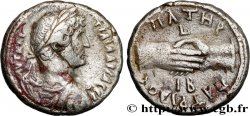
 产品介绍
产品介绍

Your Recently Viewed Items
50 Lire ITALY 1943 PM.20a XF
31.00 €
PHILIPPUS Tétradrachme syro-phénicien AU
74.00 €

ELAGABALUS Tétradrachme syro-phénicien XF
30.00 €
10 francs Mathieu 1987 Pessac F.365/14 MS60
5.00 €

1 centime Cérès 1885 Paris F.104/12 MS62
55.00 €
ANGLETERRE - ROYAUME D'ANGLETERRE - ÉDOUARD Ier Penny n.d. Canterbury VF
20.00 €
cgb.fr 集币


