


fme_1086679 - III REPUBLIC Médaille, Exposition Universelle
80.00 €约 635.20 CNY
数量
加入购物车

种类 Médaille, Exposition Universelle
日期: 1900
铸币厂名称/城市 Paris
材质 silver plated bronze
直径 37 mm
模子方针 12 h.
重量 14,37 g.
侧面 lisse
印模 sans poinçon
稀少度 R2
关于品相的说明
Patine hétérogène avec des traces d’usure et rayures. Taches d’oxydation. Argenture partie notamment sur la tranche
正面
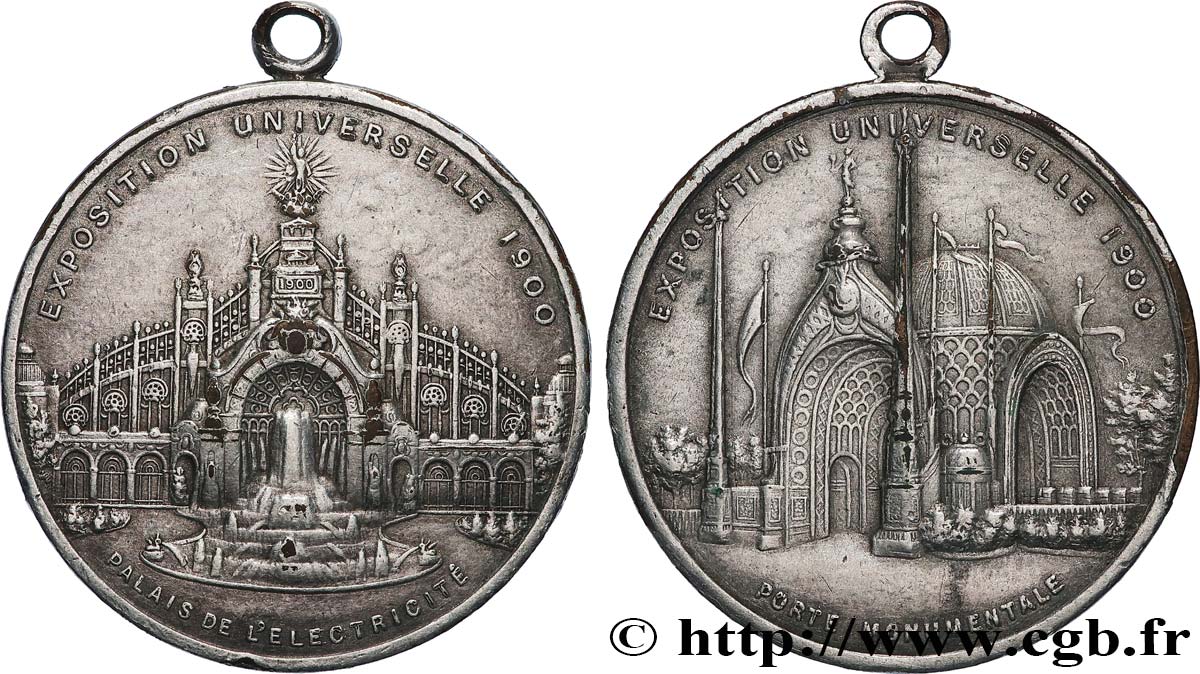
正面的文字 EXPOSITION UNIVERSELLE 1900 / PALAIS DE L’ELECTRICITE.
正面的说明书 Le palais de l’électricité.
背面
背面的文字 EXPOSITION UNIVERSELLE 1900 / PORTE MONUMENTALE.
背面的说明书 La porte du palais de l’électricité.
评论
Médaille avec un diamètre sans bélière de 33 mm
Jeux et Exposition Universelle se superposèrent. L'Exposition Universelle s'est tenue du 14 avril au 12 novembre 1900 avec plus de 50 millions de visiteurs et 83.000 exposants.
Les expositions universelles ont été créées pour présenter les réalisations industrielles des différentes nations. Elles représentaient la vitrine technologique et industrielle des participants, témoignant du progrès au cours de la révolution industrielle. La première exposition universelle s'est déroulée à Londres en 1851.
À l'origine, chaque pays disposait d'un espace réservé dans un pavillon central. À partir de 1867, des pavillons nationaux firent leur apparition. En principe, ils étaient attribués seulement s'il y avait des choses à présenter que le pavillon central ne pouvait accueillir. Ils ne tardèrent pas à se généraliser, les nations exposantes construisant des pavillons typiques de l'architecture de leurs pays.
La compétition était omniprésente dans les expositions universelles, et des concours permettaient aux plus méritants d'obtenir des médailles bénéficiant d'un certain prestige.
De nombreuses réalisations architecturales construites à l'occasion d'expositions universelles sont devenues par la suite des symboles des villes qui les ont abritées : la tour Eiffel à Paris, l'Atomium à Bruxelles, le Space Needle à Seattle, la Biosphère à Montréal.
Enfin, la tenue des expositions universelles a toujours été l'occasion de mettre en place des projets d'urbanisme : construction du métro de Paris en 1900 ou celui de Montréal en 1967, extension du métro de Lisbonne en 1998…
Voir http://fr.wikipedia.org/wiki/Exposition_universelle .
Medal with a diameter of 33 mm without the bail. The Games and the Universal Exhibition overlapped.. The Universal Exhibition was held from April 14 to November 12, 1900, with over 50 million visitors and 83. 000 exhibitors.
World's fairs were created to showcase the industrial achievements of different nations.. They represented the technological and industrial showcase of the participants, bearing witness to the progress made during the industrial revolution.. The first World's Fair took place in London in 1851..
Originally, each country had its own reserved space in a central pavilion.. From 1867 onwards, national pavilions began to appear.. In principle, they were only allocated if there were things to display that the central pavilion could not accommodate.. They soon became widespread, with exhibiting nations building pavilions typical of their countries' architecture..
Competition was omnipresent at world's fairs, and contests allowed the most deserving to obtain medals that carried a certain prestige..
Many architectural achievements built for world's fairs have subsequently become symbols of the cities that hosted them: the Eiffel Tower in Paris, the Atomium in Brussels, the Space Needle in Seattle, the Biosphere in Montreal.
Finally, the holding of world's fairs has always been an opportunity to implement urban planning projects: the construction of the Paris metro in 1900 or that of Montreal in 1967, the extension of the Lisbon metro in 1998… See http://fr. Wikipedia. org/wiki/Exposition_universelle
Jeux et Exposition Universelle se superposèrent. L'Exposition Universelle s'est tenue du 14 avril au 12 novembre 1900 avec plus de 50 millions de visiteurs et 83.000 exposants.
Les expositions universelles ont été créées pour présenter les réalisations industrielles des différentes nations. Elles représentaient la vitrine technologique et industrielle des participants, témoignant du progrès au cours de la révolution industrielle. La première exposition universelle s'est déroulée à Londres en 1851.
À l'origine, chaque pays disposait d'un espace réservé dans un pavillon central. À partir de 1867, des pavillons nationaux firent leur apparition. En principe, ils étaient attribués seulement s'il y avait des choses à présenter que le pavillon central ne pouvait accueillir. Ils ne tardèrent pas à se généraliser, les nations exposantes construisant des pavillons typiques de l'architecture de leurs pays.
La compétition était omniprésente dans les expositions universelles, et des concours permettaient aux plus méritants d'obtenir des médailles bénéficiant d'un certain prestige.
De nombreuses réalisations architecturales construites à l'occasion d'expositions universelles sont devenues par la suite des symboles des villes qui les ont abritées : la tour Eiffel à Paris, l'Atomium à Bruxelles, le Space Needle à Seattle, la Biosphère à Montréal.
Enfin, la tenue des expositions universelles a toujours été l'occasion de mettre en place des projets d'urbanisme : construction du métro de Paris en 1900 ou celui de Montréal en 1967, extension du métro de Lisbonne en 1998…
Voir http://fr.wikipedia.org/wiki/Exposition_universelle .
Medal with a diameter of 33 mm without the bail. The Games and the Universal Exhibition overlapped.. The Universal Exhibition was held from April 14 to November 12, 1900, with over 50 million visitors and 83. 000 exhibitors.
World's fairs were created to showcase the industrial achievements of different nations.. They represented the technological and industrial showcase of the participants, bearing witness to the progress made during the industrial revolution.. The first World's Fair took place in London in 1851..
Originally, each country had its own reserved space in a central pavilion.. From 1867 onwards, national pavilions began to appear.. In principle, they were only allocated if there were things to display that the central pavilion could not accommodate.. They soon became widespread, with exhibiting nations building pavilions typical of their countries' architecture..
Competition was omnipresent at world's fairs, and contests allowed the most deserving to obtain medals that carried a certain prestige..
Many architectural achievements built for world's fairs have subsequently become symbols of the cities that hosted them: the Eiffel Tower in Paris, the Atomium in Brussels, the Space Needle in Seattle, the Biosphere in Montreal.
Finally, the holding of world's fairs has always been an opportunity to implement urban planning projects: the construction of the Paris metro in 1900 or that of Montreal in 1967, the extension of the Lisbon metro in 1998… See http://fr. Wikipedia. org/wiki/Exposition_universelle
历史细节
III REPUBLIC
(4/09/1870-10/07/1940)
The news of the capitulation of Sedan provokes the revolution of September 4, 1870 in Paris. Proclaimed at the Hôtel de Ville, the Republic is endowed with a provisional government called the Government of National Defense. Threatened on the left by the insurrection of the Commune and on the right by the monarchists, the new regime had a difficult start.. Initially head of the executive power (February 1871), Thiers was responsible for reorganizing the country before choosing its form of government.. He became President of the Republic in August 1871 and, despite his action to liberate the territory, had to leave his post in March 1873 in the face of royalist opposition.. He is then replaced by Mac-Mahon favorable to the restoration of the monarchy but this one is not restored following the question of the flag. The law of the septennat was then put in place in November 1873 and then, in 1875, the fundamental laws were passed which served as the Constitution of the Third Republic.. Parliamentary system, it is characterized in particular by the clear preponderance of the legislative power on the executive power. Anticlerical, the Third Republic makes school free, secular and compulsory but continues the colonial policy for its economic, strategic and moral ambitions. Separation of Church and State was passed in 1905.. The idea of revenge on Germany and significant nationalism are at the heart of the Boulangist crisis, the Panama scandal or the Dreyfus affair of the years 1886-1899, while foreign policy is very active, particularly in Morocco and that the arms race develops. The First World War was expensive for France, which only recovered from 1920 or even 1928 for the coin with the "Poincaré" franc.. The crisis of 1929 is felt only from 1932 but lasts until 1939, a period during which ministerial instability is very important. Wavering in 1934, the Third Republic found a new unitary cement with anti-fascism which enabled the Popular Front to come to power in 1936.. But, paralyzed against Germany, France was then bogged down in a "phony war" and then suffered one of the greatest defeats in its history in June 1940.. Gathered in the National Assembly in Vichy on July 10, 1940, the Chambers, although elected in 1936, voted full powers to Pétain in a sort of collective suicide by 569 votes for, 80 votes against and 18 abstentions..
 对产品描述纠错
 打印
打印 分享我的选择
 提问
提问 Consign / sell
类似物品

 产品介绍
产品介绍


Your Recently Viewed Items

III REPUBLIC Médaille, Exposition Universelle AU
80.00 €

CYPRUS 1 Piastre Georges VI 1949 AU
10.00 €
cgb.fr 集币


