


fme_440897 - ITALY - PAPAL STATES - PIUS VII (Barnaba Chiaramonti) Médaille, Musée Chiaramonti
无库存.
所有在网站上销售的产品 (2020)
价格 : 320.00 €
所有在网站上销售的产品 (2020)
价格 : 320.00 €
种类 Médaille, Musée Chiaramonti
日期: 1822
铸币厂名称/城市 Italie, Rome
材质 silver
直径 40,5 mm
模子方针 12 h.
硬币制模工 GERBARA Giuseppe
重量 35,3 g.
侧面 Lisse
关于品相的说明
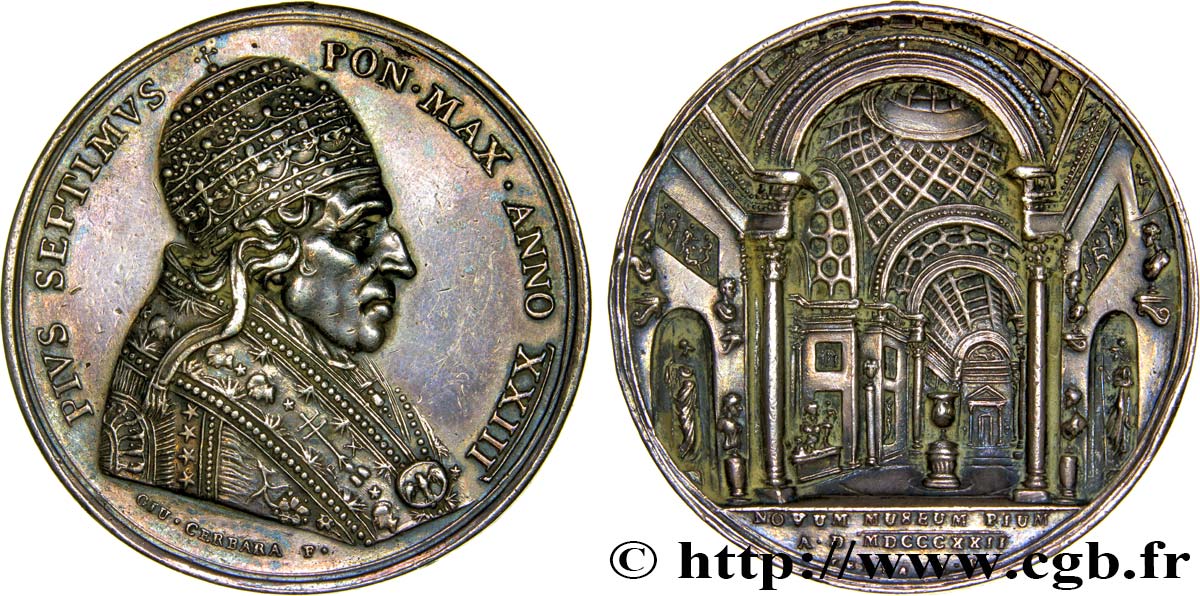
Superbe et intéressante médaille avec de beaux reliefs et une agréable patine irisée. La tranche est percée à midi (vestige de bélière)
正面
正面的文字 PIVS SEPTIMVS / PON. MAX. ANNO XXIII.
正面的说明书 Buste à droite du pape Pie VII, portant la tiare.
背面
背面的文字 NOVUM MUSEUM PIUM / A. D. MDCCCXXII.
背面的说明书 Vue intérieure du musée.
评论
Installé dans la galerie qui relie le Palais du Belvédère à l’ensemble des Palais du Vatican, le Musée Chiaramonti porte le nom du pape Pie VII Chiaramonti (1800-1823) et marque une étape fondamentale dans l’histoire des collections vaticanes. Suite au Traité de Tolentino (1797), l’Etat pontifical avait dû céder à la France de Napoléon les chefs-d’œuvre les plus importants du Musée Pio-Clementino. Après le Congrès de Vienne (1815), presque toutes les sculptures qui avaient été saisies furent récupérées grâce à l’habileté diplomatique de l’artiste Antonio Canova. Une vaste campagne d’acquisitions, menée auprès des antiquaires romains et des archéologues qui travaillaient dans l’Etat pontifical, permit alors, dès 1806, la création d’un nouveau musée.
Canova dicta lui-même les critères d’aménagement qui visaient à présenter les « trois arts sœurs » : la sculpture, dans les œuvres de l’Antiquité exposées ; l’architecture, dans les petites consoles réalisées à partir d’anciennes corniches et la peinture, dans les fresques. Ces dernières ont été peintes par de jeunes artistes contemporains, aux frais de Canova. Le cycle de peintures illustrait la générosité du pape à l’égard des arts et des monuments de Rome ; dans la lunette du mur XXI, on voit les œuvres du Vatican qui reviennent de France. Dans sa rigueur, l’aménagement, qui évite d’isoler les chefs-d’œuvre et privilégie une comparaison réciproque, subit l’influence des idées de Quatremère de Quincy qui, très critique à l’égard des saisies françaises, estimait qu’on ne pouvait comprendre les œuvres d’art que si elles étaient exposées dans leur lieu d’origine et placées non loin d’exemplaires de qualité inférieure. Comptant plus d’un millier de pièces de sculpture antique, le Musée Chiaramonti présente une des collections les plus riches en portraits romains, mais il renferme aussi beaucoup de sculptures de type idéalisé et funéraire.
cf. http://www.museivaticani.va.
Housed in the gallery that connects the Belvedere Palace to the other Vatican Palaces, the Chiaramonti Museum bears the name of Pope Pius VII Chiaramonti (1800-1823) and marks a fundamental step in the history of Vatican collections.. Following the Treaty of Tolentino (1797), the Papal States had to cede the most important masterpieces of the Pio Clementino Museum to Napoleon's France.. After the Congress of Vienna (1815), almost all the sculptures that had been seized were recovered thanks to the diplomatic skill of the artist Antonio Canova. A vast acquisition campaign, carried out among Roman antiquarians and archaeologists working in the Papal States, then enabled, from 1806, the creation of a new museum.
Canova himself dictated the layout criteria which aimed to present the \\\"three sister arts\\\": sculpture, in the works of Antiquity exhibited; architecture, in the small consoles made from old cornices; and painting, in the frescoes.. These were painted by young contemporary artists, at Canova's expense.. The cycle of paintings illustrated the Pope's generosity towards the arts and monuments of Rome; in the lunette of wall XXI, we see the Vatican works returned from France. In its rigor, the arrangement, which avoids isolating the masterpieces and favors a reciprocal comparison, is influenced by the ideas of Quatremère de Quincy who, very critical of the French seizures, believed that one could only understand works of art if they were exhibited in their place of origin and placed not far from copies of inferior quality.. With over a thousand pieces of ancient sculpture, the Chiaramonti Museum presents one of the richest collections of Roman portraits, but it also contains many idealized and funerary sculptures..
cf. http://www. Museivaticani. go
Canova dicta lui-même les critères d’aménagement qui visaient à présenter les « trois arts sœurs » : la sculpture, dans les œuvres de l’Antiquité exposées ; l’architecture, dans les petites consoles réalisées à partir d’anciennes corniches et la peinture, dans les fresques. Ces dernières ont été peintes par de jeunes artistes contemporains, aux frais de Canova. Le cycle de peintures illustrait la générosité du pape à l’égard des arts et des monuments de Rome ; dans la lunette du mur XXI, on voit les œuvres du Vatican qui reviennent de France. Dans sa rigueur, l’aménagement, qui évite d’isoler les chefs-d’œuvre et privilégie une comparaison réciproque, subit l’influence des idées de Quatremère de Quincy qui, très critique à l’égard des saisies françaises, estimait qu’on ne pouvait comprendre les œuvres d’art que si elles étaient exposées dans leur lieu d’origine et placées non loin d’exemplaires de qualité inférieure. Comptant plus d’un millier de pièces de sculpture antique, le Musée Chiaramonti présente une des collections les plus riches en portraits romains, mais il renferme aussi beaucoup de sculptures de type idéalisé et funéraire.
cf. http://www.museivaticani.va.
Housed in the gallery that connects the Belvedere Palace to the other Vatican Palaces, the Chiaramonti Museum bears the name of Pope Pius VII Chiaramonti (1800-1823) and marks a fundamental step in the history of Vatican collections.. Following the Treaty of Tolentino (1797), the Papal States had to cede the most important masterpieces of the Pio Clementino Museum to Napoleon's France.. After the Congress of Vienna (1815), almost all the sculptures that had been seized were recovered thanks to the diplomatic skill of the artist Antonio Canova. A vast acquisition campaign, carried out among Roman antiquarians and archaeologists working in the Papal States, then enabled, from 1806, the creation of a new museum.
Canova himself dictated the layout criteria which aimed to present the \\\"three sister arts\\\": sculpture, in the works of Antiquity exhibited; architecture, in the small consoles made from old cornices; and painting, in the frescoes.. These were painted by young contemporary artists, at Canova's expense.. The cycle of paintings illustrated the Pope's generosity towards the arts and monuments of Rome; in the lunette of wall XXI, we see the Vatican works returned from France. In its rigor, the arrangement, which avoids isolating the masterpieces and favors a reciprocal comparison, is influenced by the ideas of Quatremère de Quincy who, very critical of the French seizures, believed that one could only understand works of art if they were exhibited in their place of origin and placed not far from copies of inferior quality.. With over a thousand pieces of ancient sculpture, the Chiaramonti Museum presents one of the richest collections of Roman portraits, but it also contains many idealized and funerary sculptures..
cf. http://www. Museivaticani. go
历史细节
ITALY - PAPAL STATES - PIUS VII (Barnaba Chiaramonti)
(14/03/1800-20/08/1823)
Pius VII (08/14/1740-08/20/1823) succeeded Pius VI after a long vacancy on the papal throne. Pius VI had died in captivity in Valencia on August 29, 1799 and the republic had been proclaimed in Rome on February 15, 1798. It lasted until September 29, 1799. Rome was then successively occupied by the Neapolitans and the Austrians until July 3. 1800. Pius VII had been elected on March 14. The first part of his pontificate was occupied by his relations with the French Republic, then with Napoleon I. He signed the concordat with Bonaparte in 1801 and crowned him at Notre-Dame on December 2, 1804. Rome was occupied in 1808 and the Papal States confiscated the following year, while the pope was "invited" to Fontainebleau. He remained there until 1814. Freed by the fall of the emperor, he returned to Rome and spent the last eight years of his pontificate restoring his temporal and spiritual authority. He welcomed Napoleon's family to Rome. He died in 1823.
 对产品描述纠错
 打印
打印 分享我的选择
 提问
提问 Consign / sell
类似物品

 产品介绍
产品介绍


cgb.fr 集币


