


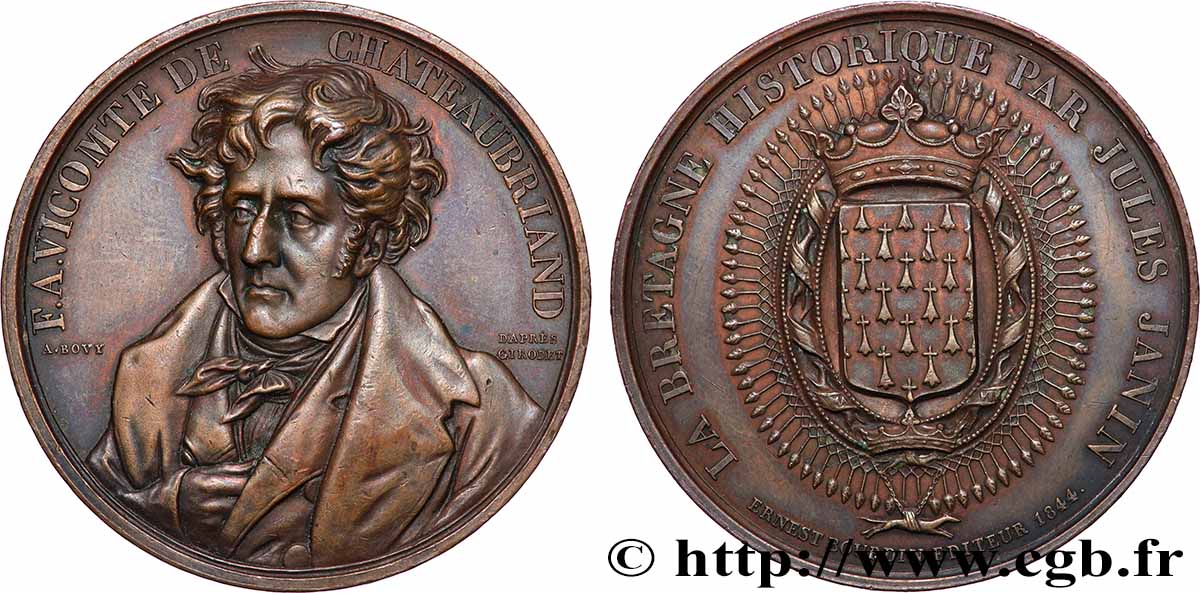
fme_1119170 - LOUIS-PHILIPPE I Médaille, Jules Janin, Vicomte de Chateaubriand, refrappe
60.00 €约 439.80 CNY
数量
加入购物车

种类 Médaille, Jules Janin, Vicomte de Chateaubriand, refrappe
日期: 1844
材质 copper
直径 41 mm
模子方针 12 h.
硬币制模工 BOVY Antoine (1795-1877)
重量 39,72 g.
侧面 lisse + proue CUIVRE
印模 Proue CUIVRE
关于品相的说明
Patine hétérogène, légèrement irisée, avec des traces d’usure, rayures et taches d’oxydation
出版目录中的项代码 :
正面
正面的文字 F. A. VICOMTE DE - CHATEAUBRIAND.
正面的说明书 Buste habillé de trois quarts face de Chateaubriand, signé : A. BOVY - D’APRES GIRODET.
背面
背面的文字 LA BRETAGNE HISTORIQUE PAR JULES JANIN.
背面的说明书 Écu couronné de Bretagne, signé : ERNEST BOURDIN EDITEUR 1844..
评论
Gabriel-Jules Janin, né à Saint-Étienne le 16 février 18041 est mort à Paris le 19 juin 1874, est un écrivain et critique dramatique français.
Fils d’un avocat, Janin reçoit une bonne éducation, d’abord dans sa ville natale puis au lycée Louis-le-Grand à Paris. Après un passage dans l’étude de l’avoué Jean-Baptiste Guillonnet-Merville, où il sera saute-ruisseau en même temps qu’Honoré de Balzac, il devient journaliste et travaille notamment à la Revue de Paris, à la Revue des deux Mondes, au Figaro et à la Quotidienne. Il fut parmi les fondateurs de la Revue de Paris et du Journal des Enfants. Il se fait connaître en 1827 avec le roman L’Âne mort et la femme guillotinée. La Confession en 1830, un peu moins profond, mais au style encore plus remarquable, et Barnave en 1831, où il attaque la famille d’Orléans, finissent d’asseoir sa réputation.
Entre-temps, il entre comme critique au Journal des Débats où il reste quarante ans. Son autorité le fait surnommer « le prince des critiques ».
Gabriel-Jules Janin, born in Saint-Étienne on February 16, 1804, died in Paris on June 19, 1874, was a French writer and drama critic. The son of a lawyer, Janin received a good education, first in his hometown and then at the Lycée Louis-le-Grand in Paris. After a stint in the office of the lawyer Jean-Baptiste Guillonnet-Merville, where he was a leaping brook at the same time as Honoré de Balzac, he became a journalist and worked notably for the Revue de Paris, the Revue des deux Mondes, Le Figaro and La Quotidienne. He was among the founders of the Revue de Paris and the Journal des Enfants. He became known in 1827 with the novel The Dead Donkey and the Guillotined Woman. The Confession in 1830, a little less profound, but with an even more remarkable style, and Barnave in 1831, in which he attacks the Orléans family, finally established his reputation. In the meantime, he joined the Journal des Débats as a critic, where he remained for forty years. His authority earned him the nickname \\\"the prince of critics.\\\"
历史细节
LOUIS-PHILIPPE I
(7/08/1830-24/02/1848)
Born in Paris in 1773, Louis-Philippe is the eldest son of Louis-Philippe Joseph, Duke of Orléans (Philippe-Égalité), guillotined in 1793 for corruption after having voted for the death of his cousin Louis XVI. He successively bears the titles of Duke of Valois, Chartres and Orleans from 1793. Favorable to the Revolution, like his father, he nevertheless had to take refuge in Switzerland then he traveled to Scandinavia, the United States and finally settled in England in 1801.. The Restoration allows him to find the immense possessions of his family but he remains considered as a potential rival by Louis XVIII who receives him coldly. Refugee in England during the Hundred Days, he returned to France in 1817. Greedy for gain, he gave his support to the opposition represented by the liberal party while relying on the possessing upper middle class.. The days of 1830 gave him the opportunity to come to power after having adhered to the tricolor flag and multiplied the promises. He became on July 31, 1830 lieutenant general of the kingdom then king of the French on August 7. His reign, under a liberal appearance, will become that of the bourgeoisie and business circles while the oppositions (Legitimists, Bonapartists, Republicans and Socialists) are maintained illegally.. His peace policy and his authority then earned him significant prestige with the European courts.. The banker Laffitte is Prime Minister. La Fayette is one of the architects of this "bourgeois revolution". On March 13, 1831, Casimir Périer replaced Laffitte. France intervenes in Belgium in August 1831 to counter the Dutch. The Legitimists, with the rue des Prouvaires plot, try to establish Henry V as king while his mother tries to raise the Vendée. She was arrested on December 3, 1832 in Nantes.. The cholera epidemic kills more than ten thousand people in Paris, including Casimir Périer. General Lamarque's funeral was the occasion for an attempted republican uprising, crushed in blood (see. Wretched). The French occupy Antwerp on December 23, 1832.. Fieschi's attack of July 28, 1835 against Louis-Philippe kills eighteen people including Marshal Mortier. The first Paris-Orléans railway line and the July column were inaugurated on October 24, 1837 and July 28, 1840 respectively.. The year 1840 marked a turning point in the regime, with great ministerial instability before having the Guizot ministry ("Get rich!").. Prince Louis-Napoleon Bonaparte, after a second putsch attempt, was sentenced to life imprisonment and locked up in Fort Ham from which he escaped in 1846. Napoleon's ashes are brought from Saint Helena and transferred to Les Invalides. From 1841, Louis-Philippe committed France to the path of the total conquest of Algeria, already begun under Charles X, while a major economic boom developed in Metropolitan France.. A law in 1841 limits child labor to 12 hours. The first serious railway accident took place on the Paris-Versailles line and caused 45 deaths on May 8, 1842. On July 13, the Duke of Orleans, the king's eldest son, died accidentally. On May 16, 1843, the Duke of Aumale took the smala of Abd-el-Kader who managed to escape. Bugeaud, Governor of Algeria, is made Marshal. 1843 is also the beginning of the Entente Cordiale and the visit of Queen Victoria to France. The French beat the Moroccans at Isly. Abd-el-Kader surrenders on December 23, 1847. The refusal of reforms leads to the fall of the regime during the Banquet Campaign and Louis-Philippe, dethroned on February 24, 1848, takes refuge in England after having abdicated in favor of his grandson..
 对产品描述纠错
 打印
 分享我的选择
 提问
 Consign / sell

 产品介绍


Your Recently Viewed Items

LOTS Lot de 5 monnaies lot
150.00 €

10 francs Jimenez 1986 F.373/3 MS62 PCGS
110.00 €

UNITED KINGDOM 1 Shilling Guillaume IV 1834 XF
75.00 €
cgb.fr 集币


