


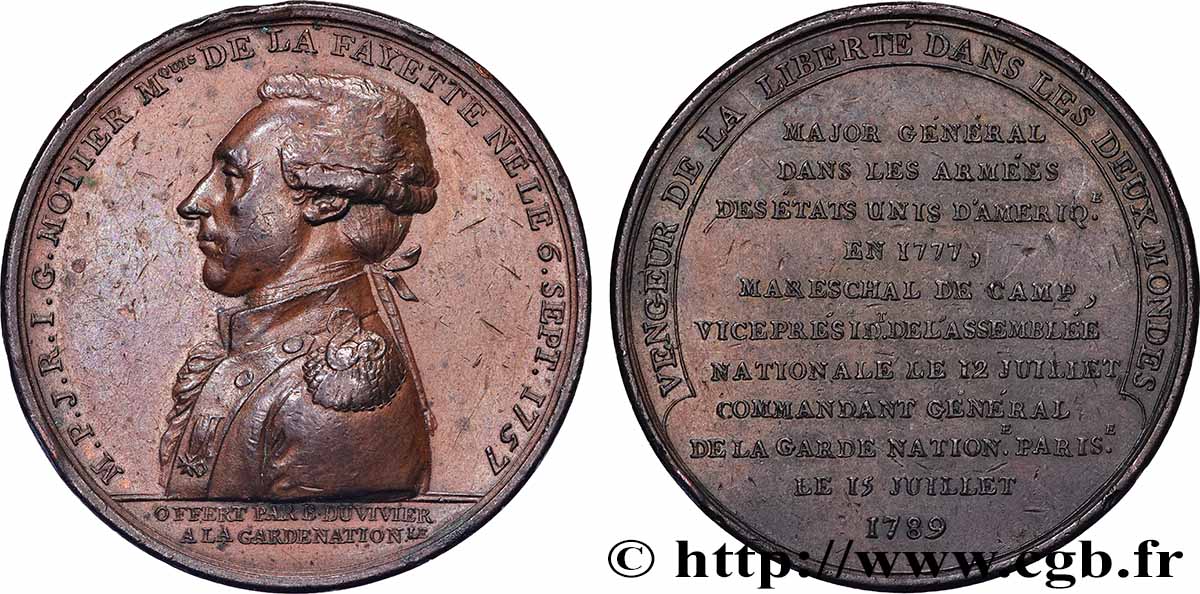
Live auction - fme_1151898 - LOUIS XVI Médaille, Marquis de La Fayette
得先注册又得到批准才可以报价。为了报价注册. 客户应该得到公司允许,那种过程需要 48 个小时。别等出售结束那一天才登记。您报价的话等于您赞成买那物品,而且按« 保价 » 证明您接受 cgb.fr 因特网拍卖使用法.
报价时只可以出全数值欧元总额。物品描述也说明销售结束时间,结束后出价都不会生效。 报价命令转达有时变动,等到最后秒钟增加否决的可能会。想多了解的话请注意 因特网拍卖常问
最高出价方将支付18%的不含税的拍卖费用
最高出价方将支付18%的不含税的拍卖费用
| 估算 : | 200 € |
| 价格 : | 100 € |
| 最高出价 : | 120 € |
| 拍卖结束日期 : | 25 August 2026 18:26:54 |
| 竞拍人 : | 1 竞拍人 |
种类 Médaille, Marquis de La Fayette
日期: 1789
材质 bronze
直径 41,5 mm
模子方针 12 h.
硬币制模工 DUVIVIER Benjamin (1730-1819)
重量 32,03 g.
侧面 lisse
印模 sans poinçon
关于品相的说明
Patine marron hétérogène avec des taches d’oxydation. Présence de coups et rayures, notamment sur la tranche
出版目录中的项代码 :
正面
正面的文字 M. P. J. R. I. G. MOTIER MQUIS DE LA FAYETTE NÉ LE 6 SEPTEMBRE 1757 // OFFERT PAR B. DUVIVIER / A LA GARDE NATIONALE.
正面的说明书 Buste habillé à gauche du Marquis de La Fayette.
背面
背面的文字 VENGEUR DE LA LIBERTÉ DANS LES DEUX MONDES // MAJOR GÉNÉRAL / DANS LAS ARMÉES / DES ÉTATS UNIS D’AMÉRIQUE / EN 1777, / MARESCHAL DE CAMP, / VICE PRÉSIDENT DE L’ASSEMBLÉE / NATIONALE LE 12 JUILLET / COMMANDANT GÉNÉRAL / DE LA GARDE NATIONALE PARIS / LE 15 JUILLET / 1789.
背面的说明书 Légende circulaire et en 11 lignes.
评论
Gilbert du Motier, marquis de La Fayette, dit « La Fayette », né le 6 septembre 1757 au château de Chavaniac, paroisse de Saint-Georges-d'Aurac (province d'Auvergne, actuellement Chavaniac-Lafayette dans la Haute-Loire) et mort le 20 mai 1834 à Paris (ancien 1er arrondissement), est un noble d'orientation libérale, officier et homme politique français. Nommé général par George Washington, Lafayette a joué un rôle décisif aux côtés des Américains dans leur guerre d'indépendance contre le pouvoir colonial britannique et en particulier lors de la victoire de Yorktown le 19 octobre 1781. Lafayette a aussi œuvré à l'émergence en France d'un pouvoir royal moderne, avant de devenir une personnalité de la Révolution française jusqu'à son émigration, son arrestation et sa mise en prison pour cinq ans en 1792. Lafayette fut aussi un acteur politique majeur des débuts de la monarchie de Juillet. Surnommé le « héros des deux mondes », il est l'un des huit citoyens d'honneur des États-Unis d'Amérique.
Après la révolution de 1789, La Fayette décide de signer tous ses courriers d'un « Lafayette » en un seul mot, en réaction contre le système nobiliaire. C'est aussi la graphie utilisée par ses contemporains jusqu'à sa mort.
Gilbert du Motier, Marquis de La Fayette, known as \\\"La Fayette\\\", born on September 6, 1757 at the Château de Chavaniac, parish of Saint-Georges-d'Aurac (province of Auvergne, currently Chavaniac-Lafayette in Haute-Loire) and died on May 20, 1834 in Paris (former 1st arrondissement), was a nobleman of liberal orientation, officer and French politician. Appointed general by George Washington, Lafayette played a decisive role alongside the Americans in their war of independence against the British colonial power and in particular during the victory at Yorktown on October 19, 1781.. Lafayette also worked towards the emergence of a modern royal power in France, before becoming a figure of the French Revolution until his emigration, arrest and imprisonment for five years in 1792.. Lafayette was also a major political player in the early days of the July Monarchy.. Nicknamed the \\\"hero of two worlds,\\\" he is one of eight honorary citizens of the United States of America..
After the revolution of 1789, Lafayette decided to sign all his letters with a single word \\\"Lafayette\\\", in reaction against the nobility system.. This is also the spelling used by his contemporaries until his death.
Après la révolution de 1789, La Fayette décide de signer tous ses courriers d'un « Lafayette » en un seul mot, en réaction contre le système nobiliaire. C'est aussi la graphie utilisée par ses contemporains jusqu'à sa mort.
Gilbert du Motier, Marquis de La Fayette, known as \\\"La Fayette\\\", born on September 6, 1757 at the Château de Chavaniac, parish of Saint-Georges-d'Aurac (province of Auvergne, currently Chavaniac-Lafayette in Haute-Loire) and died on May 20, 1834 in Paris (former 1st arrondissement), was a nobleman of liberal orientation, officer and French politician. Appointed general by George Washington, Lafayette played a decisive role alongside the Americans in their war of independence against the British colonial power and in particular during the victory at Yorktown on October 19, 1781.. Lafayette also worked towards the emergence of a modern royal power in France, before becoming a figure of the French Revolution until his emigration, arrest and imprisonment for five years in 1792.. Lafayette was also a major political player in the early days of the July Monarchy.. Nicknamed the \\\"hero of two worlds,\\\" he is one of eight honorary citizens of the United States of America..
After the revolution of 1789, Lafayette decided to sign all his letters with a single word \\\"Lafayette\\\", in reaction against the nobility system.. This is also the spelling used by his contemporaries until his death.
历史细节
LOUIS XVI
(05/10/1774-01/21/1793)
Born in Versailles in 1754, Louis XVI was the son of Louis, Dauphin of France, and Marie-Josèphe de Saxe. In 1774, king on the death of his ancestor Louis XV, he called to his side the old count of Maurepas, disgraced since 1749, and soon separated from the ministers of his predecessor, this "triumvirate" formed by the chancellor Maupeou, the Abbé Terray and the Duc d'Aiguillon, who, through his authoritarian policy, had just restored the royal authority. The old Parliament of Paris, abolished since 1770, was restored. On August 24, 1774, Louis XVI dismissed Terray and appointed Turgot Comptroller General of Finances. Refusing to be a simple "money collector" during his ministry, Turgot multiplied the economic reforms. At the end of 1775, the Comptroller General had begun financial recovery: taxes brought in 327 million, 67 more than the previous year; the deficit was reduced to 15 million. But his plans hurt too many vested interests. Everything was against him: the devotees, the parliaments, the Choiseul party, Queen Marie-Antoinette, whose role was incredibly harmful, the Court, the financiers. He needed the support of an enlightened despot, and Louis XVI was neither despot enough nor enlightened enough.. The revolt of the English colonies in America, in 1775, heated the spirits in France. A whole party wanted to erase the memory of the disastrous Seven Years' War. On May 9, 1776, a secret council, from which Turgot was excluded, decided to enter the war; on the 12th, the Comptroller General was dismissed at the same time as the Keeper of the Seals Malesherbes, after a ministry of less than two years. Thanks to French help, the insurgents prevailed in America and the Treaty of Versailles (1783) recognized the independence of the United States.. But France had gained little in this war which increased the financial distress of the State. Necker, successor to Turgot from 1777 to 1781, also had to give way before the coalition of the privileged. With the financial crisis worsening, the king summoned an Assembly of Notables (1787), which refused the necessary changes. Necker, recalled to business (1788), had the king decide to convene the States General, the first since 1614. The first part of the reign of Louis XVI was marked by numerous reforms: establishment of the Mont-de-Piété (1777), abolition of serfdom in the royal domain (1779), abolition of the preparatory question (1780), creation of the school of mines (1783), beginning of the dyke of Cherbourg and the Canal du Center (1784), freedom of the grain trade (1787), edict of tolerance in favor of Protestants (1788). In generalities, a generation of high-class intendants continued the work of their predecessors during the reign of Louis XV.. But these reforms were not enough to stop the march of time. When it appointed its representatives, the nation disavowed the enlightened administrators from the Council and the intendancies. From 1789 to 1792, in three short years, the ancient political and social edifice crumbled irreparably. The giant of the Grand Siècle had lived. Opened on May 5, 1789, the States General declared themselves the National Assembly on June 17 and, on August 4, abolished the old privileges. However, the king's brothers left France. In October, the royal family was brought back to Paris and the Assembly followed it there: henceforth, the history of France was going to be written in the capital.. The Revolution continued, and, as time passed, Louis XVI, who only approved by mouth the transformations in progress, was no more than the plaything of events.. Brought back to Paris after the failure of his flight abroad (June 1791), he had to sanction the new constitution which reduced him to the rank of first civil servant of the State.. The war against Austria, desired by Louis XVI (April 1792), precipitated the fall of the regime. Accused of duplicity, the king was overthrown by the Parisian riot and the Legislative Assembly had to endorse the abolition of the monarchy (August 10, 1792) before giving way to a National Convention. It was before this body that the trial of the king took place (December 1792-1793), who, condemned to death, was executed on January 21, 1793.. With the reign of Louis XVI, the history of the French monarchy really comes to an end.. No doubt there will still be kings of France, a Restoration, this "comedy of fifteen years", a king of the French, two emperors, no doubt it will take France a century to establish itself definitively as a Republic, but it It was in 1792 that the chain of time, uninterrupted for fifteen centuries, was broken, at the same time as the bond of love between the monarch and his subjects was broken.. Constantly inferior to their task since their accession to the throne, Louis XVI and his wife showed exceptional dignity and courage as soon as they descended from it.. Their long martyrdom, from August 1792 to July 1793, crowns the destiny of a monarchy which, since its birth, had prided itself on being entirely Christian..
 对产品描述纠错
 打印
打印 分享我的选择
 提问
提问 Consign / sell
类似物品

 产品介绍
产品介绍



Your Recently Viewed Items
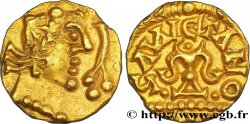
MEROVINGIAN COINAGE - BANASSAC (BANNACIACO) - Lozere Triens au vase et au rameau
2800.00 €

FLANDRE WALLONNE (ÉTATS DE LA ...) FLANDRE FRANCAISE XF
60.00 €
50 centimes Napoléon III, tête nue 1860 Paris F.187/13 AU53
63.00 €

V REPUBLIC Médaille, Chambre d'agriculture d'Ille-et-Vilaine AU/AU
55.00 €

CONSULAT Médaille, Élection de la Colonne Nationale, place Vendôme XF
60.00 €
LORRAINE - DUCHÉ DE LORRAINE - FRANÇOIS III Médaille, Les Ducs de Lorraine AU
50.00 €
cgb.fr 集币


