


fjt_072876 - NORMANDIE (NOBLESSE ET VILLES DE...) Jeton Ar 28, prieur et juges-consuls de Dieppe 1762

无库存.
所有在网站上销售的产品 (2012)
价格 : 35.00 €
所有在网站上销售的产品 (2012)
价格 : 35.00 €
种类 Jeton Ar 28, prieur et juges-consuls de Dieppe
日期: 1762
材质 silver
直径 28 mm
模子方针 6 h.
侧面 cannelée
关于品相的说明
Très bel exemplaire avec une usure régulière de circulation
出版目录中的项代码 :
正面
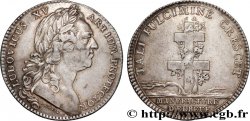
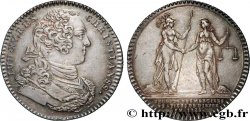
正面的文字 LUD. XV. REX. - CHRISTIANISS..
正面的说明书 Buste lauré et drapé à droite de Louis XV [n° 342] ; au-dessous signature R. FIL. .
正面的翻译 (Louis XV, roi très chrétien).
背面
背面的文字 CIVICO. FŒDERE PRODERIT ; À L'EXERGUE EN DEUX LIGNES : ÆDIL. DEPPÆ COMIT./ 1762.
背面的说明书 Écu aux armes de Dieppe sur un cartouche surmonté d’une tête d’ange et soutenu par deux Néréides ; signature D. V..
背面的翻译 (Elle sera utile à l'alliance civile - Assemblée des notables de Dieppe).
评论
Les juridictions consulaires remontent à Henri II. Dans ces lieux de réunions, les marchands élisent entre eux un prieur et deux juges-consuls qui règlent en première instance les problèmes entre négociants. Les juges-consuls ou juges des tribunaux de commerce sont établis par un édit de 1563. Ils étaient souvent d’anciens consuls (officiers municipaux) d’où leur nom. Au XVIIIe siècle, les juges-consuls jugeaient souverainement jusqu’à 500 livres (au-delà, l’affaire relevait des Parlements).
Consular courts date back to Henry II. In these meeting places, merchants elected a prior and two consul judges who settled disputes between traders in the first instance. Consul judges, or judges of the commercial courts, were established by an edict of 1563. They were often former consuls (municipal officers), hence their name. In the 18th century, consul judges had sovereign jurisdiction up to 500 livres (beyond this, the matter fell under the jurisdiction of the Parlements).
Consular courts date back to Henry II. In these meeting places, merchants elected a prior and two consul judges who settled disputes between traders in the first instance. Consul judges, or judges of the commercial courts, were established by an edict of 1563. They were often former consuls (municipal officers), hence their name. In the 18th century, consul judges had sovereign jurisdiction up to 500 livres (beyond this, the matter fell under the jurisdiction of the Parlements).
历史细节
NORMANDY (GENTRY AND TOWNS OF...)
Normandy covers on the one hand the region of Rouen or upper Normandy around the Seine valley and on the other hand lower Normandy around Caen with the Cotentin and the Pays d'Auge. Inhabited since the Paleolithic era, the Seine valley is an important way of trade and habitation, and is then occupied by various Celtic peoples such as the Calètes, the Véliocasses or the Aulerques Éburovices. Roman, it then passes into the kingdom of Syagrius before being occupied by the Franks from 486. Ravaged by the incursions of the Normans, the region was recognized by Charles the Simple.. The Dukes of Normandy were then the allies of the first Capetians and in the 11th century were at the head of one of the richest and best administratively organized states in Europe, which is also shown by the expansion towards southern Italy and england. In the French monarchy, Normandy keeps its institutions, for example with the maintenance of the Exchequer, or its customary law codified in the "Grand Coutumier". Deeply affected during the Wars of Religion, Normandy saw its last vestiges of independence disappear in the 17th century following the revolts of the "Barefoot". The textile industry was favored under Colbert which gave a new economic boost to Normandy.
 对产品描述纠错
 打印
打印 分享我的选择
 提问
提问 Consign / sell
类似物品

 产品介绍
产品介绍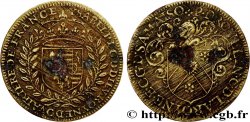

Your Recently Viewed Items
50 Francs QUENTIN DE LA TOUR FRANCE 1986 F.67.12 UNC-
40.00 €
SLOVENIA SÉRIE Euro BRILLANT UNIVERSEL - FRANCE PREŠEREN 2007 Brilliant Uncirc
30.00 €

GUINEA-BISSAU 1 Escudo monnayage colonial Portugais, cincentenaire de la découv
6.00 €
ITALY - KINGDOM OF ITALY - NAPOLEON I 5 Lire 1807 Milan VF
79.00 €
100 Francs LUC OLIVIER MERSON type modifié FRANCE 1939 F.25.40 UNC-
420.00 €
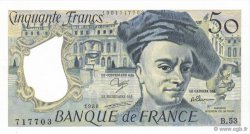
50 Francs QUENTIN DE LA TOUR FRANCE 1988 F.67.14 UNC-
44.78 €
cgb.fr 集币


