


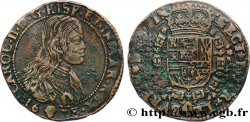
fwo_1085805 - PAYS-BAS ESPAGNOLS - DUCHÉ DE BRABANT - CHARLES II D'ESPAGNE Liard 1693 Anvers


正面
正面的文字 .CAROL. II. D. G. HISP. ET. INDIARUM. R..
正面的说明书 Écus d'Autriche, Bourgogne ancien et Brabant autour d'un briquet couronné.
正面的翻译 (Charles II, par la grâce de Dieu, roi d'Espagne et des Indes).
背面
背面的文字 .ARCHID. AVST. DVX. BVRG. BRAB. Z 16-93.
背面的说明书 Écu écartelé au 1 contre-écartelé en a et d de Castille, en b et c de Léon ; au 2 mi-parti d'Aragon et de Sicile sur le tout de Portugal, enté en pointe de Grenade ; au 3 d'Autriche soutenu de Bourgogne ancien ; au 4 de Bourgogne moderne soutenu de Brabant ; sur le tout mi-parti de Flandre et de Tyrol.
背面的翻译 (Archiduc d'Autriche, duc de Bourgogne et de Brabant, etc.).
历史细节
SPANISH NETHERLANDS - DUCHY OF BRABANT - CHARLES II OF SPAIN
(17/11/1665-1/11/1700)
Charles II (6/11/1661-1/11/1700) is the son of Philip IV of Spain and Marie-Anne of Austria. Last offspring of the Habsburgs of Spain and Austria, he has trouble standing up and suffers from many family flaws. He is king at the death of his father, at four years old, under the regency of his mother. He married Marie Louise d'Orléans (1662-1689), the daughter of Philippe d'Orléans, the niece of Louis XIV. His reign marks the reduction of Spanish power and the loss of many provinces: Franche-Comté, French Flanders. Charles, the great patient of Europe, died in 1700 without a direct heir and instituted Philippe, Duke of Anjou, grandson of Louis XIV, as heir to the throne of Spain. This is the beginning of the War of Spanish Succession (1700-1713).
 对产品描述纠错
 打印
打印 分享我的选择
 提问
提问 Consign / sell
类似物品

 产品介绍
产品介绍
Your Recently Viewed Items

PAYS-BAS ESPAGNOLS - DUCHÉ DE BRABANT - CHARLES II D'ESPAGNE Liard 1693 Anvers
30.00 €
cgb.fr 集币


