


fme_381220 - III REPUBLIC Médaille du corps municipal
无库存.
所有在网站上销售的产品 (2016)
价格 : 120.00 €
所有在网站上销售的产品 (2016)
价格 : 120.00 €
种类 Médaille du corps municipal
日期: 1914
铸币厂名称/城市 75 - Paris
材质 silver
直径 50 mm
模子方针 12 h.
硬币制模工 CHAPLAIN Jules (1839-1909) / DUPUIS Daniel (1849-1899)
重量 60 g.
侧面 lisse + corne 1 ARGENT
关于品相的说明
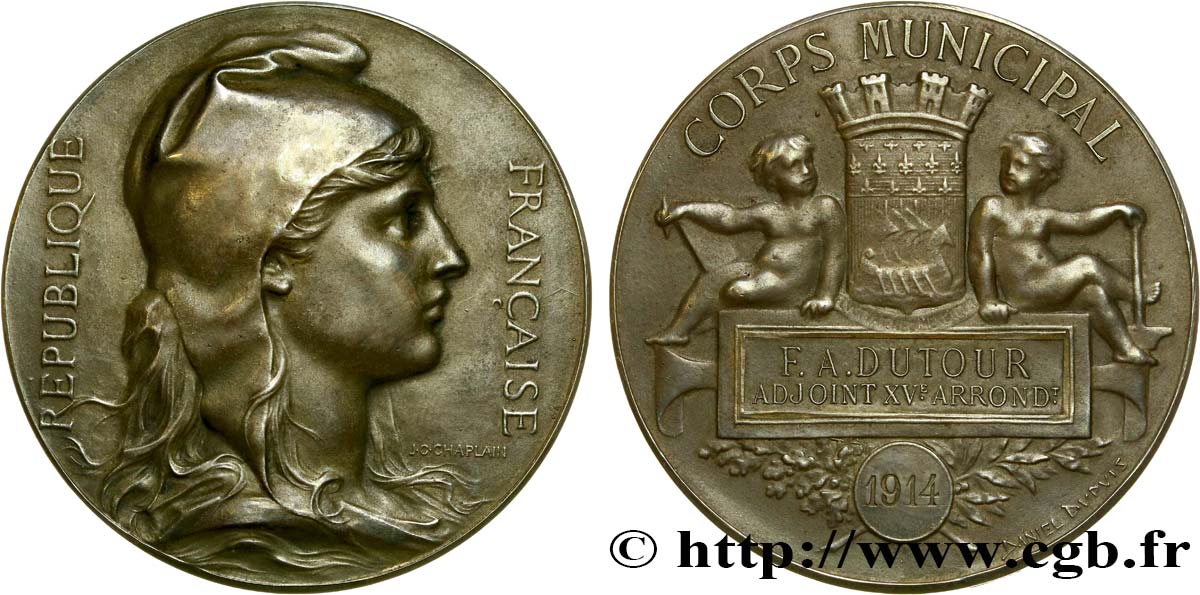
Agréable médaille avec une épaisse patine sombre et homogène. Médaille dans son étui en cuir d’origine
正面
正面的文字 RÉPUBLIQUE / FRANÇAISE.
正面的说明书 Tête de Marianne à droite, la chevelure sous un bonnet phrygien.
背面
背面的文字 CORPS MUNICIPAL // F. A. DUTOUR / ADJOINT XVE ARRONDT // 1914.
背面的说明书 Deux putti assis sur un cartouche, de part et d’autre d’un écu couronné aux armes de Paris ; date dans un médaillon posé sur une branche de laurier et de chêne à l’exergue.
评论
Intéressante combinaison de deux graveurs renommés ; le droit est signé de Champlain et le revers de Daniel Dupuis.
Jules-Clément Chaplain, dit Jules Chaplain, né à Mortagne-au-Perche le 12 juillet 1839 et mort à Paris le 13 juillet 1909, est un sculpteur, graveur-médailleur français. Graveur reconnu et admiré à la fin du xixe siècle pour ses séries de médailles, il passe à la postérité surtout pour la gravure des pièces de 10 et 20 francs-or du système monétaire français qui sont frappées de 1899 à 1914. Il réalise des médailles pour l'Exposition universelle de 1867, l'exposition universelle de 1878 et pour l'exposition universelle de 1900. Le louis ou napoléon de la Troisième République présente au droit une tête de Marianne coiffée du bonnet phrygien et couronnée de feuilles de chêne. Au revers, le coq et la devise « Liberté - Égalité - Fraternité ». La guerre de 1914 aura raison du système du franc germinal.
Jean-Baptiste-Daniel Dupuis, dit Daniel Dupuis, né le 17 février 1849 à Blois (Loir-et-Cher) et mort le 13 novembre 1899 à Paris, est un peintre, sculpteur et graveur-médailleur français. Il est le fils du peintre Étienne-Denis Dupuis et le frère de Pierre Dupuis, également peintre. Son père le fait entrer en 1865 à l’École des beaux-arts de Paris, où il est élève de Jules Cavelier. Il obtient le second prix de Rome de gravure en 1868. Au même moment, il est reçu au concours comme professeur de dessin pour les écoles de la ville de Paris. En 1872, au lendemain de la guerre franco-prussienne, il est lauréat du premier grand prix de Rome pour la gravure en médailles. Il obtient le premier prix aux concours ouverts par la ville de Paris pour la médaille de la République française en 1879. Il reçoit également la médaille d’or à l’Exposition universelle de 1889, pour la médaille commémorative de l’exposition. Récompensé aux Salons annuels, aux expositions d’Amsterdam, d’Anvers et de Bruxelles, chevalier de la Légion d'honneur en 1881, officier en 1897, il est l’auteur de bon nombre des médailles officielles de l’époque.
Il pratique également l’art des portraits en médaillons en bronze. Il sculpte des bas-reliefs pour l’hôtel de ville de Paris et exécute des dessins pour l'Institut monétaire : des billets de banque français, comme pour le fameux 500 francs bleu et rose, d'un billet de 100 francs (1892) non circulant qui resta en réserve dans les coffres des banques centrales, mais aussi étrangers, par exemple pour l'Indochine française. Il est également l'auteur pour la Monnaie de Paris des pièces de 1, 2, 5 et 10 centime en bronze (1897-1921)..
Interesting combination of two renowned engravers; the obverse is signed by Champlain and the reverse by Daniel Dupuis.
Jules-Clément Chaplain, known as Jules Chaplain, born in Mortagne-au-Perche on July 12, 1839 and died in Paris on July 13, 1909, was a French sculptor, engraver and medalist. A renowned and admired engraver at the end of the 19th century for his series of medals, he is remembered above all for the engraving of the 10 and 20 gold franc coins of the French monetary system which were minted from 1899 to 1914.. He produced medals for the 1867 World's Fair, the 1878 World's Fair and the 1900 World's Fair.. The Louis or Napoleon of the Third Republic presents on the obverse a head of Marianne wearing a Phrygian cap and crowned with oak leaves. On the reverse, the rooster and the motto “Liberty - Equality - Fraternity”. The war of 1914 will put an end to the Germinal franc system.
Jean-Baptiste-Daniel Dupuis, known as Daniel Dupuis, born on February 17, 1849 in Blois (Loir-et-Cher) and died on November 13, 1899 in Paris, was a French painter, sculptor and engraver-medalist. He is the son of the painter Étienne-Denis Dupuis and the brother of Pierre Dupuis, also a painter.. His father admitted him to the École des Beaux-Arts in Paris in 1865, where he was a student of Jules Cavelier.. He won the second prize in Rome for engraving in 1868.. At the same time, he was accepted into the competition as a drawing teacher for the schools of the city of Paris.. In 1872, in the aftermath of the Franco-Prussian War, he won the first Grand Prix de Rome for medal engraving.. He won first prize in the competitions opened by the city of Paris for the medal of the French Republic in 1879.. He also received the gold medal at the 1889 World's Fair, for the commemorative medal of the exhibition.. Awarded prizes at the annual Salons, at the exhibitions of Amsterdam, Antwerp and Brussels, knight of the Legion of Honour in 1881, officer in 1897, he is the author of many of the official medals of the time..
He also practices the art of portraits in bronze medallions. He sculpted bas-reliefs for the Paris City Hall and executed designs for the Monetary Institute: French banknotes, such as the famous blue and pink 500 francs, a non-circulating 100 franc note (1892) which remained in reserve in the vaults of central banks, but also foreign ones, for example for French Indochina. He also created the 1, 2, 5 and 10 centime bronze coins for the Paris Mint (1897-1921)..
Jules-Clément Chaplain, dit Jules Chaplain, né à Mortagne-au-Perche le 12 juillet 1839 et mort à Paris le 13 juillet 1909, est un sculpteur, graveur-médailleur français. Graveur reconnu et admiré à la fin du xixe siècle pour ses séries de médailles, il passe à la postérité surtout pour la gravure des pièces de 10 et 20 francs-or du système monétaire français qui sont frappées de 1899 à 1914. Il réalise des médailles pour l'Exposition universelle de 1867, l'exposition universelle de 1878 et pour l'exposition universelle de 1900. Le louis ou napoléon de la Troisième République présente au droit une tête de Marianne coiffée du bonnet phrygien et couronnée de feuilles de chêne. Au revers, le coq et la devise « Liberté - Égalité - Fraternité ». La guerre de 1914 aura raison du système du franc germinal.
Jean-Baptiste-Daniel Dupuis, dit Daniel Dupuis, né le 17 février 1849 à Blois (Loir-et-Cher) et mort le 13 novembre 1899 à Paris, est un peintre, sculpteur et graveur-médailleur français. Il est le fils du peintre Étienne-Denis Dupuis et le frère de Pierre Dupuis, également peintre. Son père le fait entrer en 1865 à l’École des beaux-arts de Paris, où il est élève de Jules Cavelier. Il obtient le second prix de Rome de gravure en 1868. Au même moment, il est reçu au concours comme professeur de dessin pour les écoles de la ville de Paris. En 1872, au lendemain de la guerre franco-prussienne, il est lauréat du premier grand prix de Rome pour la gravure en médailles. Il obtient le premier prix aux concours ouverts par la ville de Paris pour la médaille de la République française en 1879. Il reçoit également la médaille d’or à l’Exposition universelle de 1889, pour la médaille commémorative de l’exposition. Récompensé aux Salons annuels, aux expositions d’Amsterdam, d’Anvers et de Bruxelles, chevalier de la Légion d'honneur en 1881, officier en 1897, il est l’auteur de bon nombre des médailles officielles de l’époque.
Il pratique également l’art des portraits en médaillons en bronze. Il sculpte des bas-reliefs pour l’hôtel de ville de Paris et exécute des dessins pour l'Institut monétaire : des billets de banque français, comme pour le fameux 500 francs bleu et rose, d'un billet de 100 francs (1892) non circulant qui resta en réserve dans les coffres des banques centrales, mais aussi étrangers, par exemple pour l'Indochine française. Il est également l'auteur pour la Monnaie de Paris des pièces de 1, 2, 5 et 10 centime en bronze (1897-1921)..
Interesting combination of two renowned engravers; the obverse is signed by Champlain and the reverse by Daniel Dupuis.
Jules-Clément Chaplain, known as Jules Chaplain, born in Mortagne-au-Perche on July 12, 1839 and died in Paris on July 13, 1909, was a French sculptor, engraver and medalist. A renowned and admired engraver at the end of the 19th century for his series of medals, he is remembered above all for the engraving of the 10 and 20 gold franc coins of the French monetary system which were minted from 1899 to 1914.. He produced medals for the 1867 World's Fair, the 1878 World's Fair and the 1900 World's Fair.. The Louis or Napoleon of the Third Republic presents on the obverse a head of Marianne wearing a Phrygian cap and crowned with oak leaves. On the reverse, the rooster and the motto “Liberty - Equality - Fraternity”. The war of 1914 will put an end to the Germinal franc system.
Jean-Baptiste-Daniel Dupuis, known as Daniel Dupuis, born on February 17, 1849 in Blois (Loir-et-Cher) and died on November 13, 1899 in Paris, was a French painter, sculptor and engraver-medalist. He is the son of the painter Étienne-Denis Dupuis and the brother of Pierre Dupuis, also a painter.. His father admitted him to the École des Beaux-Arts in Paris in 1865, where he was a student of Jules Cavelier.. He won the second prize in Rome for engraving in 1868.. At the same time, he was accepted into the competition as a drawing teacher for the schools of the city of Paris.. In 1872, in the aftermath of the Franco-Prussian War, he won the first Grand Prix de Rome for medal engraving.. He won first prize in the competitions opened by the city of Paris for the medal of the French Republic in 1879.. He also received the gold medal at the 1889 World's Fair, for the commemorative medal of the exhibition.. Awarded prizes at the annual Salons, at the exhibitions of Amsterdam, Antwerp and Brussels, knight of the Legion of Honour in 1881, officer in 1897, he is the author of many of the official medals of the time..
He also practices the art of portraits in bronze medallions. He sculpted bas-reliefs for the Paris City Hall and executed designs for the Monetary Institute: French banknotes, such as the famous blue and pink 500 francs, a non-circulating 100 franc note (1892) which remained in reserve in the vaults of central banks, but also foreign ones, for example for French Indochina. He also created the 1, 2, 5 and 10 centime bronze coins for the Paris Mint (1897-1921)..
历史细节
III REPUBLIC
(4/09/1870-10/07/1940)
The news of the capitulation of Sedan provokes the revolution of September 4, 1870 in Paris. Proclaimed at the Hôtel de Ville, the Republic is endowed with a provisional government called the Government of National Defense. Threatened on the left by the insurrection of the Commune and on the right by the monarchists, the new regime had a difficult start.. Initially head of the executive power (February 1871), Thiers was responsible for reorganizing the country before choosing its form of government.. He became President of the Republic in August 1871 and, despite his action to liberate the territory, had to leave his post in March 1873 in the face of royalist opposition.. He is then replaced by Mac-Mahon favorable to the restoration of the monarchy but this one is not restored following the question of the flag. The law of the septennat was then put in place in November 1873 and then, in 1875, the fundamental laws were passed which served as the Constitution of the Third Republic.. Parliamentary system, it is characterized in particular by the clear preponderance of the legislative power on the executive power. Anticlerical, the Third Republic makes school free, secular and compulsory but continues the colonial policy for its economic, strategic and moral ambitions. Separation of Church and State was passed in 1905.. The idea of revenge on Germany and significant nationalism are at the heart of the Boulangist crisis, the Panama scandal or the Dreyfus affair of the years 1886-1899, while foreign policy is very active, particularly in Morocco and that the arms race develops. The First World War was expensive for France, which only recovered from 1920 or even 1928 for the coin with the "Poincaré" franc.. The crisis of 1929 is felt only from 1932 but lasts until 1939, a period during which ministerial instability is very important. Wavering in 1934, the Third Republic found a new unitary cement with anti-fascism which enabled the Popular Front to come to power in 1936.. But, paralyzed against Germany, France was then bogged down in a "phony war" and then suffered one of the greatest defeats in its history in June 1940.. Gathered in the National Assembly in Vichy on July 10, 1940, the Chambers, although elected in 1936, voted full powers to Pétain in a sort of collective suicide by 569 votes for, 80 votes against and 18 abstentions..
 对产品描述纠错
 打印
打印 分享我的选择
 提问
提问 Consign / sell
类似物品

 产品介绍
产品介绍


Your Recently Viewed Items

1 Piastre FRENCH INDOCHINA 1927 P.048b XF-
31.00 €

1 franc Semeuse, nickel 1973 Pessac F.226/18 MS
4.00 €
cgb.fr 集币


