


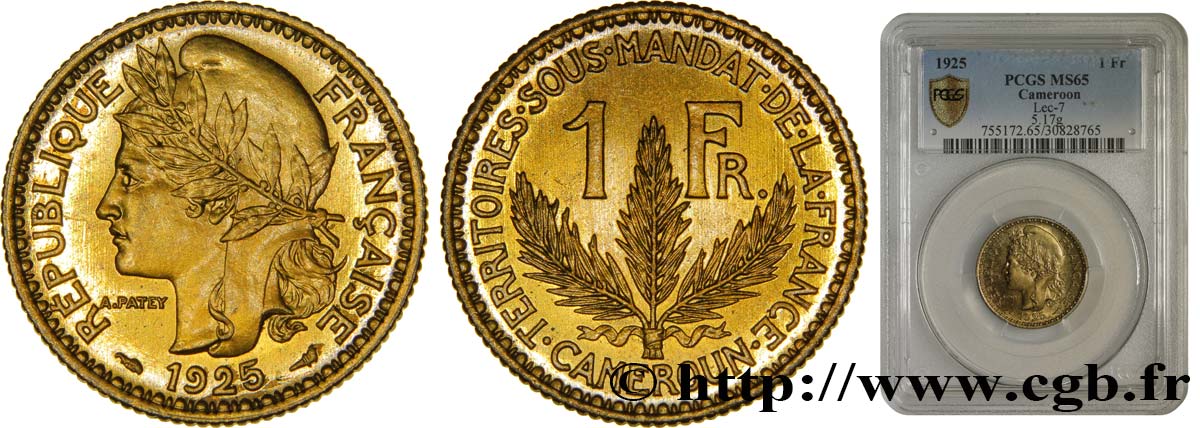
fco_318711 - CAMEROON - FRENCH MANDATE TERRITORIES 1 Franc, pré-série de Morlon poids lourd, 5 grammes 1925 Paris
无库存.
所有在网站上销售的产品 (2014)
价格 : 1 200.00 €
所有在网站上销售的产品 (2014)
价格 : 1 200.00 €
种类 1 Franc, pré-série de Morlon poids lourd, 5 grammes
日期: 1925
铸币厂名称/城市 Paris
铸币数量 1721922
材质 bronze-aluminium
直径 23,12 mm
模子方针 6 h.
重量 5,16 g.
侧面 striée
稀少度 R3
Slab

PCGS : 65
关于品相的说明
État exceptionnel pour le type, sous coque PCGS
家谱
Cet exemplaire provient de la Collection Michel
正面
正面的文字 RÉPUBLIQUE - FRANÇAISE / 1925.
正面的说明书 Marianne à gauche, portant le bonnet phrygien et couronnée de lauriers.
背面
背面的文字 .TERRITOIRES . SOUS . MANDAT . DE . LA . FRANCE. / CAMEROUN / 1 - FR..
背面的说明书 trois palmes dressées liées par un ruban.
评论
Nous pensons que cet exemplaire est en réalité une pré-série de la 1 franc Morlon dans une version de poids lourd, donc de poids standard pour la version Cameroun, et cet exemplaire peut parfaitement être considéré comme une frappe pour le Cameroun et est donc aussi référencé comme tel.
Toute la série de ces frappes pour le Togo et le Cameroun des collections Pierre et Michel ont en commun une caractéristique : les états de conservation. En effet, ces monnaies, que leurs poids soient au standard de l’émission coloniale ou sur l’étalon des Morlon, sont absolument neuves et leurs seules imperfections proviennent de manipulations, même pas de chocs entre des monnaies mais des traces de doigts. L’absence de ces petits chocs produits soit par la chute des monnaies tombant dans des bacs après frappe ou par les manipulations en sacs est totale. On pourrait donc même penser que les frappes ont été faites hors circuit industriel. Or, pour ces types, les exemplaires connus, dans le meilleur des cas et les plus belles collections, sont des exemplaires en petits superbes, la circulation en Afrique n’étant manifestement pas une sinécure pour monnaies et rien n’ayant été conservé hors circulation, en métropole.
Les exemplaires des collections Pierre et Michel ne peuvent pas être des prélèvements avant envois en Afrique : nous n’avons jamais vu de tels prélèvements, sur plusieurs millésimes différents, plusieurs valeurs faciales différentes, deux pays différents, être ainsi conservés. Autre remarque, les coins utilisés ne sont pas neufs et viennent d’être repolis : on voit le plus souvent des stries de polissage dans les champs et les reliefs sont uniformément mats sur des champs miroir ; un prélèvement se serait plutôt fait en début de production, donc avec des coins neufs, plus ou moins uniformément brillants.
On a donc tout lieu de penser que la frappe de ces exemplaires s’est faite complètement en dehors de la production standard, et après celle-ci puisque avec des coins repolis, donc probablement en 1926/1927.
Pourquoi ? Manifestement, quand on regarde les poids, le métal, les diamètres, l’époque, la seule hypothèse viable est de considérer ces monnaies comme des essais de frappe de la série Morlon. Cela explique surtout pourquoi ces exemplaires ont été conservés, sont neufs, frappés hors circuit industriel, et présentent ces variations de poids.
We believe that this example is in fact a pre-series of the 1 franc Morlon in a heavyweight version, therefore of standard weight for the Cameroon version, and this example can perfectly be considered as a strike for Cameroon and is therefore also referenced as such..
The entire series of these strikes for Togo and Cameroon from the Pierre and Michel collections have one characteristic in common: the states of conservation. In fact, these coins, whether their weights are at the standard of the colonial issue or on the Morlon standard, are absolutely new and their only imperfections come from handling, not even from shocks between coins but from fingerprints.. The absence of these small shocks produced either by the fall of coins falling into bins after striking or by handling in bags is total.. We could therefore even think that the strikes were made outside the industrial circuit.. Now, for these types, the known examples, in the best cases and the most beautiful collections, are small superb examples, circulation in Africa clearly not being a sinecure for coins and nothing having been preserved outside circulation, in mainland France..
The examples in the Pierre and Michel collections cannot be samples taken before being sent to Africa: we have never seen such samples, from several different vintages, several different face values, two different countries, being preserved in this way.. Another note, the corners used are not new and have just been repolished: we most often see polishing streaks in the fields and the reliefs are uniformly matt on mirror fields; a sample would rather have been taken at the start of production, therefore with new corners, more or less uniformly shiny.
We therefore have every reason to believe that the striking of these examples was done completely outside of standard production, and after it since with repolished dies, therefore probably in 1926/1927.
Why? Obviously, when we look at the weights, the metal, the diameters, the period, the only viable hypothesis is to consider these coins as test strikes of the Morlon series.. This mainly explains why these examples have been preserved, are new, struck outside the industrial circuit, and present these variations in weight.
Toute la série de ces frappes pour le Togo et le Cameroun des collections Pierre et Michel ont en commun une caractéristique : les états de conservation. En effet, ces monnaies, que leurs poids soient au standard de l’émission coloniale ou sur l’étalon des Morlon, sont absolument neuves et leurs seules imperfections proviennent de manipulations, même pas de chocs entre des monnaies mais des traces de doigts. L’absence de ces petits chocs produits soit par la chute des monnaies tombant dans des bacs après frappe ou par les manipulations en sacs est totale. On pourrait donc même penser que les frappes ont été faites hors circuit industriel. Or, pour ces types, les exemplaires connus, dans le meilleur des cas et les plus belles collections, sont des exemplaires en petits superbes, la circulation en Afrique n’étant manifestement pas une sinécure pour monnaies et rien n’ayant été conservé hors circulation, en métropole.
Les exemplaires des collections Pierre et Michel ne peuvent pas être des prélèvements avant envois en Afrique : nous n’avons jamais vu de tels prélèvements, sur plusieurs millésimes différents, plusieurs valeurs faciales différentes, deux pays différents, être ainsi conservés. Autre remarque, les coins utilisés ne sont pas neufs et viennent d’être repolis : on voit le plus souvent des stries de polissage dans les champs et les reliefs sont uniformément mats sur des champs miroir ; un prélèvement se serait plutôt fait en début de production, donc avec des coins neufs, plus ou moins uniformément brillants.
On a donc tout lieu de penser que la frappe de ces exemplaires s’est faite complètement en dehors de la production standard, et après celle-ci puisque avec des coins repolis, donc probablement en 1926/1927.
Pourquoi ? Manifestement, quand on regarde les poids, le métal, les diamètres, l’époque, la seule hypothèse viable est de considérer ces monnaies comme des essais de frappe de la série Morlon. Cela explique surtout pourquoi ces exemplaires ont été conservés, sont neufs, frappés hors circuit industriel, et présentent ces variations de poids.
We believe that this example is in fact a pre-series of the 1 franc Morlon in a heavyweight version, therefore of standard weight for the Cameroon version, and this example can perfectly be considered as a strike for Cameroon and is therefore also referenced as such..
The entire series of these strikes for Togo and Cameroon from the Pierre and Michel collections have one characteristic in common: the states of conservation. In fact, these coins, whether their weights are at the standard of the colonial issue or on the Morlon standard, are absolutely new and their only imperfections come from handling, not even from shocks between coins but from fingerprints.. The absence of these small shocks produced either by the fall of coins falling into bins after striking or by handling in bags is total.. We could therefore even think that the strikes were made outside the industrial circuit.. Now, for these types, the known examples, in the best cases and the most beautiful collections, are small superb examples, circulation in Africa clearly not being a sinecure for coins and nothing having been preserved outside circulation, in mainland France..
The examples in the Pierre and Michel collections cannot be samples taken before being sent to Africa: we have never seen such samples, from several different vintages, several different face values, two different countries, being preserved in this way.. Another note, the corners used are not new and have just been repolished: we most often see polishing streaks in the fields and the reliefs are uniformly matt on mirror fields; a sample would rather have been taken at the start of production, therefore with new corners, more or less uniformly shiny.
We therefore have every reason to believe that the striking of these examples was done completely outside of standard production, and after it since with repolished dies, therefore probably in 1926/1927.
Why? Obviously, when we look at the weights, the metal, the diameters, the period, the only viable hypothesis is to consider these coins as test strikes of the Morlon series.. This mainly explains why these examples have been preserved, are new, struck outside the industrial circuit, and present these variations in weight.
历史细节
CAMEROON - TERRITORIES UNDER FRENCH MANDATE
(1919-1945)
The 1884 treaty, which delivered Cameroon to the Germans, was confirmed by the Congress of Berlin the following year. Gustave Nachtigal occupied the new colony. In 1911, in order to resolve the Moroccan crisis, France ceded part of the Congo to the Germans, which was attached to Cameroon. The territory had an area of 761,000 km2 and was populated by 2.5 million inhabitants in 1914, including 2,000 whites. At the Treaty of Versailles (June 28, 1919), Cameroon, which had been occupied since 1916 by the Franco-British, became a mandate entrusted to the French. Cameroon is one of the first territories to join Free France on August 27, 1940. At the end of the war, the mandate is transformed into trusteeship and Cameroon obtains its internal autonomy in 1958 and its independence on January 1, 1960.
 对产品描述纠错
 打印
打印 分享我的选择
 提问
提问 Consign / sell
类似物品
 产品介绍
产品介绍


Your Recently Viewed Items

50 Nouveaux Francs HENRI IV FRANCE 1959 F.58.01 VF-
110.00 €
COUNTY OF FLANDRE - LOUIS II Gros ou demi-botdraeger VF
61.00 €

HISPANIA - HISPANO-CARTAGIENSIS Demi-unité de bronze au palmier et à la tête
65.00 €
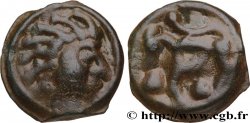
SENONES (Area of Sens) Potin à la tête “d’indien” XF
32.00 €

LOUIS XIV "THE SUN KING" Demi-écu aux trois couronnes 1713 Dijon AU
250.00 €

CAMEROON - FRENCH MANDATE TERRITORIES 1 Franc, pré-série de Morlon poids lourd
1200.00 €
cgb.fr 集币


