


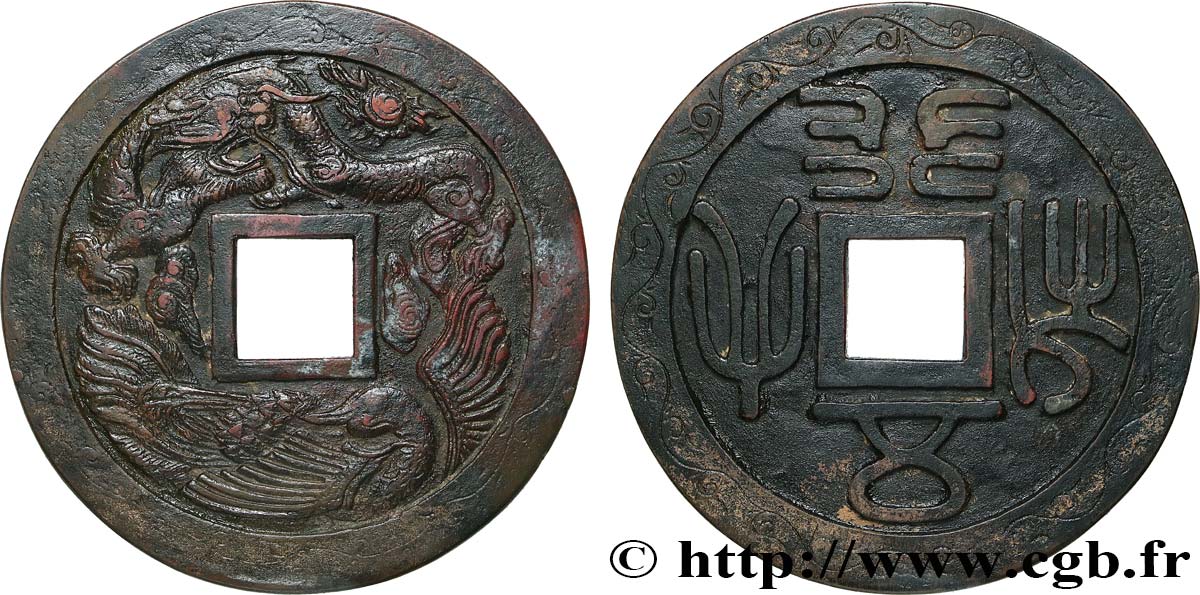
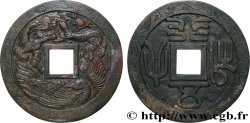
fme_644024 - CHINA Médaille de mariage, Grande amulette, reproduction
数量
加入购物车

种类 Médaille de mariage, Grande amulette, reproduction
日期: (fin XXe siècle)
材质 bronze
直径 148 mm
模子方针 12 h.
重量 470,44 g.
侧面 lisse
印模 sans poinçon
关于品相的说明
Patine hétérogène avec des taches noires et des traces de vernis un peu collant. Marques d’usure sur certains reliefs
出版目录中的项代码 :
家谱
Cet exemplaire provient de la Collection Terisse
正面
正面的文字 (LÉGENDE EN SINOGRAMME CHINOIS) WU XING DA BU.
正面的翻译 Grande monnaie des cinq éléments.
背面
背面的文字 ANÉPIGRAPHE.
背面的说明书 Dragon, Phénix et Perle flamboyante (symbolisant l’harmonie du couple Homme et Femme et la richesse spirituelle).
评论
Attention ! Cette médaille peut faire lieu à des frais de port supplémentaires.
Warning ! This medal may give rise to additional shipping costs.
Médaille de la fin du XXe siècle ! Il ne s’agit pas d’une production ancienne mais d’une médaille récente, probablement une reproduction ou copie.
Medal of the end of the XXth century, this medal is probably a replica as the time of production is recent.
D’après l’ouvrage, Amulette de Chine et du Viet-nam par François Thierry, “les pièces portant l’image de ces deux animaux fantastiques (dragon et phénix) étaient offertes lors des mariages en voeux de bonheur et d’harmonie et portent le nom générique “longfeng qian” soit pièces du dragon et du phénix”.
NB. «La théorie des cinq éléments est l’une des bases de la poésie chinoise ; très en vogue sous les Han, elle structure l’ensemble des phénomènes naturels, physiques, sociaux, intellectuels selon cinq catégories qui se succédent dans un cycle comprenant une montée, un apogée et une décadence. Ces catégories s’appuient sur cinq éléments, qui se succèdent en s’annihilant.».
Attention! This medal may incur additional shipping costs. Warning! This medal may give rise to additional shipping costs. Medal from the end of the 20th century! This is not an antique piece but a recent medal, probably a reproduction or copy. According to the book, Amulets of China and Vietnam by François Thierry, “coins bearing the image of these two fantastic animals (dragon and phoenix) were given at weddings as wishes for happiness and harmony and are known generically as “longfeng qian,” meaning dragon and phoenix coins.” Note: “The theory of the five elements is one of the foundations of Chinese poetry; very popular during the Han dynasty, it structures all natural, physical, social, and intellectual phenomena according to five categories that follow one another in a cycle comprising a rise, a peak, and a decline.” These categories are based on five elements, which follow one another and cancel each other out.
Warning ! This medal may give rise to additional shipping costs.
Médaille de la fin du XXe siècle ! Il ne s’agit pas d’une production ancienne mais d’une médaille récente, probablement une reproduction ou copie.
Medal of the end of the XXth century, this medal is probably a replica as the time of production is recent.
D’après l’ouvrage, Amulette de Chine et du Viet-nam par François Thierry, “les pièces portant l’image de ces deux animaux fantastiques (dragon et phénix) étaient offertes lors des mariages en voeux de bonheur et d’harmonie et portent le nom générique “longfeng qian” soit pièces du dragon et du phénix”.
NB. «La théorie des cinq éléments est l’une des bases de la poésie chinoise ; très en vogue sous les Han, elle structure l’ensemble des phénomènes naturels, physiques, sociaux, intellectuels selon cinq catégories qui se succédent dans un cycle comprenant une montée, un apogée et une décadence. Ces catégories s’appuient sur cinq éléments, qui se succèdent en s’annihilant.».
Attention! This medal may incur additional shipping costs. Warning! This medal may give rise to additional shipping costs. Medal from the end of the 20th century! This is not an antique piece but a recent medal, probably a reproduction or copy. According to the book, Amulets of China and Vietnam by François Thierry, “coins bearing the image of these two fantastic animals (dragon and phoenix) were given at weddings as wishes for happiness and harmony and are known generically as “longfeng qian,” meaning dragon and phoenix coins.” Note: “The theory of the five elements is one of the foundations of Chinese poetry; very popular during the Han dynasty, it structures all natural, physical, social, and intellectual phenomena according to five categories that follow one another in a cycle comprising a rise, a peak, and a decline.” These categories are based on five elements, which follow one another and cancel each other out.
历史细节
CHINA
 对产品描述纠错
 打印
打印 分享我的选择
 提问
提问 Consign / sell
类似物品
 产品介绍
产品介绍


Your Recently Viewed Items
CHINA Médaille de mariage, Grande amulette, reproduction XF
600.00 €
cgb.fr 集币


