


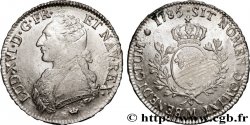
v18_1732 - LOUIS XVI Médaille Ar 41 pour la naissance de Marie-Thérèse, “Madame Royale”

MONNAIES 18 (2003)
起拍价 : 230.00 €
估价 : 380.00 €
竞价记录 : 230.00 €
出价数量 : 1
最高出价 : 340.00 €
起拍价 : 230.00 €
估价 : 380.00 €
竞价记录 : 230.00 €
出价数量 : 1
最高出价 : 340.00 €
种类 Médaille Ar 41 pour la naissance de Marie-Thérèse, “Madame Royale”
日期: 1778
铸币厂名称/城市 Paris, Monnaie du Louvre
材质 silver
直径 41,5 mm
模子方针 12 h.
硬币制模工 Benjamin Duvivier (1728-1819)
重量 32,13 g.
侧面 lisse
稀少度 R1
关于品相的说明
De minimes marques de frottement et de manipulation dans les champs. Exemplaire superbe
正面
正面的文字 LUD. XVI. REX - CHRISTIANISS. .
正面的说明书 Grand buste de Louis XVI drapé, tête nue à droite ; au-dessous signature : B. DU VIVIER F..
正面的翻译 (Louis XVI roi très chrétien).
背面
背面的文字 FŒCUNDITATIS AUGUSTÆ PIGNUS ET OMEN ; À L'EXERGUE EN QUATRE LIGNES : NATAL. MARIÆ THER. CAR./ REGIS PRIMOG./ XIX. DEC. /MDCCLXXVIII..
背面的说明书 La France couronnée et drapée assise de face, présentant un bébé.
评论
Marie-Thérèse Charlotte est le premier des quatre enfants de Louis XVI et de Marie-Antoinette, née le 19 décembre 1778. Prisonnière au temple, elle assiste impuissante au départ de son père puis de sa mère et enfin de son frère, le dauphin Louis, né en 1785. Elle n’apprendra que plus tard leurs disparitions. Seule rescapée, elle est échangée par le Directoire contre des prisonniers comme le citoyen Drouet, l’un des responsables de l’arrestation de 1791. En exil, elle retrouve et suit Louis XVIII dans les différentes demeures qui voulurent bien accueillir les restes de la famille royale de France. Elle épouse en 1799 Louis-Antoine, duc d’Angoulême, son cousin qui ne lui donnera aucune descendance. De retour en France avec la Restauration, elle se bat lors des Cent-jours avec acharnement dans la ville de Bordeaux ce qui lui vaut d’être qualifiée de “seul homme de la famille” par l’Empereur. Elle meurt en 1851.
Marie-Thérèse Charlotte was the first of the four children of Louis XVI and Marie-Antoinette, born on December 19, 1778. A prisoner in the temple, she watched helplessly as her father, then her mother, and finally her brother, the Dauphin Louis, born in 1785, left. She would only learn of their disappearances later. The only survivor, she was exchanged by the Directory for prisoners such as Citizen Drouet, one of those responsible for the 1791 arrest. In exile, she found and followed Louis XVIII to the various residences that were willing to welcome the remains of the French royal family. In 1799, she married Louis-Antoine, Duke of Angoulême, her cousin who would not give her any descendants. Returning to France with the Restoration, she fought fiercely during the Hundred Days in the city of Bordeaux, earning her the title of “the only man in the family” from the Emperor. She died in 1851
Marie-Thérèse Charlotte was the first of the four children of Louis XVI and Marie-Antoinette, born on December 19, 1778. A prisoner in the temple, she watched helplessly as her father, then her mother, and finally her brother, the Dauphin Louis, born in 1785, left. She would only learn of their disappearances later. The only survivor, she was exchanged by the Directory for prisoners such as Citizen Drouet, one of those responsible for the 1791 arrest. In exile, she found and followed Louis XVIII to the various residences that were willing to welcome the remains of the French royal family. In 1799, she married Louis-Antoine, Duke of Angoulême, her cousin who would not give her any descendants. Returning to France with the Restoration, she fought fiercely during the Hundred Days in the city of Bordeaux, earning her the title of “the only man in the family” from the Emperor. She died in 1851
历史细节
LOUIS XVI
(05/10/1774-01/21/1793)
Born in Versailles in 1754, Louis XVI was the son of Louis, Dauphin of France, and Marie-Josèphe de Saxe. In 1774, king on the death of his ancestor Louis XV, he called to his side the old count of Maurepas, disgraced since 1749, and soon separated from the ministers of his predecessor, this "triumvirate" formed by the chancellor Maupeou, the Abbé Terray and the Duc d'Aiguillon, who, through his authoritarian policy, had just restored the royal authority. The old Parliament of Paris, abolished since 1770, was restored. On August 24, 1774, Louis XVI dismissed Terray and appointed Turgot Comptroller General of Finances. Refusing to be a simple "money collector" during his ministry, Turgot multiplied the economic reforms. At the end of 1775, the Comptroller General had begun financial recovery: taxes brought in 327 million, 67 more than the previous year; the deficit was reduced to 15 million. But his plans hurt too many vested interests. Everything was against him: the devotees, the parliaments, the Choiseul party, Queen Marie-Antoinette, whose role was incredibly harmful, the Court, the financiers. He needed the support of an enlightened despot, and Louis XVI was neither despot enough nor enlightened enough.. The revolt of the English colonies in America, in 1775, heated the spirits in France. A whole party wanted to erase the memory of the disastrous Seven Years' War. On May 9, 1776, a secret council, from which Turgot was excluded, decided to enter the war; on the 12th, the Comptroller General was dismissed at the same time as the Keeper of the Seals Malesherbes, after a ministry of less than two years. Thanks to French help, the insurgents prevailed in America and the Treaty of Versailles (1783) recognized the independence of the United States.. But France had gained little in this war which increased the financial distress of the State. Necker, successor to Turgot from 1777 to 1781, also had to give way before the coalition of the privileged. With the financial crisis worsening, the king summoned an Assembly of Notables (1787), which refused the necessary changes. Necker, recalled to business (1788), had the king decide to convene the States General, the first since 1614. The first part of the reign of Louis XVI was marked by numerous reforms: establishment of the Mont-de-Piété (1777), abolition of serfdom in the royal domain (1779), abolition of the preparatory question (1780), creation of the school of mines (1783), beginning of the dyke of Cherbourg and the Canal du Center (1784), freedom of the grain trade (1787), edict of tolerance in favor of Protestants (1788). In generalities, a generation of high-class intendants continued the work of their predecessors during the reign of Louis XV.. But these reforms were not enough to stop the march of time. When it appointed its representatives, the nation disavowed the enlightened administrators from the Council and the intendancies. From 1789 to 1792, in three short years, the ancient political and social edifice crumbled irreparably. The giant of the Grand Siècle had lived. Opened on May 5, 1789, the States General declared themselves the National Assembly on June 17 and, on August 4, abolished the old privileges. However, the king's brothers left France. In October, the royal family was brought back to Paris and the Assembly followed it there: henceforth, the history of France was going to be written in the capital.. The Revolution continued, and, as time passed, Louis XVI, who only approved by mouth the transformations in progress, was no more than the plaything of events.. Brought back to Paris after the failure of his flight abroad (June 1791), he had to sanction the new constitution which reduced him to the rank of first civil servant of the State.. The war against Austria, desired by Louis XVI (April 1792), precipitated the fall of the regime. Accused of duplicity, the king was overthrown by the Parisian riot and the Legislative Assembly had to endorse the abolition of the monarchy (August 10, 1792) before giving way to a National Convention. It was before this body that the trial of the king took place (December 1792-1793), who, condemned to death, was executed on January 21, 1793.. With the reign of Louis XVI, the history of the French monarchy really comes to an end.. No doubt there will still be kings of France, a Restoration, this "comedy of fifteen years", a king of the French, two emperors, no doubt it will take France a century to establish itself definitively as a Republic, but it It was in 1792 that the chain of time, uninterrupted for fifteen centuries, was broken, at the same time as the bond of love between the monarch and his subjects was broken.. Constantly inferior to their task since their accession to the throne, Louis XVI and his wife showed exceptional dignity and courage as soon as they descended from it.. Their long martyrdom, from August 1792 to July 1793, crowns the destiny of a monarchy which, since its birth, had prided itself on being entirely Christian..
 对产品描述纠错
 打印
打印 分享我的选择
 提问
提问 Consign / sell
类似物品

 产品介绍
产品介绍


cgb.fr 集币


