


bpv_192763 - VESPASIANUS Tétradrachme syro-phénicien

无库存.
所有在网站上销售的产品
价格 : 48.00 €
所有在网站上销售的产品
价格 : 48.00 €
种类 Tétradrachme syro-phénicien
日期: an 2
铸币厂名称/城市 Antioche, Syrie, Séleucie et Piérie
材质 silver
直径 24 mm
模子方针 12 h.
重量 12,49 g.
关于品相的说明
Flan étroit et épais comme toujours pour cette émission, faible usure de circulation mais fortes traces de corrosion tant au droit qu’au revers
出版目录中的项代码 :
家谱
Cet exemplaire est le 0112_013
正面
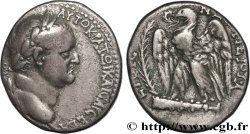
正面的说明书 Tête laurée de Vespasien à droite (O*).
正面铭文 AUTOKRAT KAISA OUESPASIANOU, (Autokratoros Kaisaros ouespasianou)
正面的翻译 (L'empereur césar Vespasien).
背面
背面的说明书 Aigle debout à gauche sur une massue, les ailes déployées.
背面铭文 ETOUS B IEROU (Etous b Ierou)
背面的翻译 (deuxième année sainte).
评论
Les monnaies du troisième groupe des frappes de Vespasien, caractérisées par un aigle à gauche sur une massue, sans couronne dans le bec, sont du style d’Alexandrie mais de la datation syrienne avec la lettre annuelle surmontée d’une barre. Les quantités frappées suivent les besoins : les frappes les plus massives sont celles de l’An 2, fin de la Guerre juive et elles se terminent en l’An 5 avec des quantités frappées décroissantes au fil des années.
Plusieurs graveurs participent à cette série où celui de notre exemplaire est très bien représenté. On doit remarquer que les pièces des groupes dits au style d’Alexandrie ont une caractéristique commune : l’aigle ne tient pas de couronne (groupes 1, 2 et 3) dans le bec. Ceci renforce l’idée que cette couronne était une distinction attribuée à la ville émettrice et que nous aurions affaire à un atelier militaire ou plus simplement à un atelier - quelque soit sa localisation - fourni en métal par le Trésor Militaire, sans lien organique avec une ville.
Dans la base TSP maintenue par Michel Prieur, quatre-vingt onze exemplaires sont maintenant répertoriés.
The coins of the third group of Vespasian's strikes, characterized by an eagle facing left on a club, without a crown in the beak, are of the Alexandrian style but of the Syrian dating with the annual letter surmounted by a bar. The quantities struck follow the needs: the most massive strikes are those of Year 2, end of the Jewish War and they end in Year 5 with decreasing quantities struck over the years. Several engravers participate in this series where that of our example is very well represented. It should be noted that the coins of the groups called Alexandrian style have a common characteristic: the eagle does not hold a crown (groups 1, 2 and 3) in the beak. This reinforces the idea that this crown was a distinction attributed to the issuing city and that we would be dealing with a military mint or more simply a mint - whatever its location - supplied with metal by the Military Treasury, without organic link with a city. In the TSP database maintained by Michel Prieur, ninety-one examples are now listed
Plusieurs graveurs participent à cette série où celui de notre exemplaire est très bien représenté. On doit remarquer que les pièces des groupes dits au style d’Alexandrie ont une caractéristique commune : l’aigle ne tient pas de couronne (groupes 1, 2 et 3) dans le bec. Ceci renforce l’idée que cette couronne était une distinction attribuée à la ville émettrice et que nous aurions affaire à un atelier militaire ou plus simplement à un atelier - quelque soit sa localisation - fourni en métal par le Trésor Militaire, sans lien organique avec une ville.
Dans la base TSP maintenue par Michel Prieur, quatre-vingt onze exemplaires sont maintenant répertoriés.
The coins of the third group of Vespasian's strikes, characterized by an eagle facing left on a club, without a crown in the beak, are of the Alexandrian style but of the Syrian dating with the annual letter surmounted by a bar. The quantities struck follow the needs: the most massive strikes are those of Year 2, end of the Jewish War and they end in Year 5 with decreasing quantities struck over the years. Several engravers participate in this series where that of our example is very well represented. It should be noted that the coins of the groups called Alexandrian style have a common characteristic: the eagle does not hold a crown (groups 1, 2 and 3) in the beak. This reinforces the idea that this crown was a distinction attributed to the issuing city and that we would be dealing with a military mint or more simply a mint - whatever its location - supplied with metal by the Military Treasury, without organic link with a city. In the TSP database maintained by Michel Prieur, ninety-one examples are now listed
历史细节
VESPASIAN
(1/07/69-24/06/79)
Vespasien was born on November 17, 9 in Flacrines, near Reate (in Sabine country). He belongs to the Italian municipal bourgeoisie. Aedile in 38, lender in 40, consul in 51, proconsul of Africa in 63, he commanded with Claude the expedition to Brittany. Nero entrusted him with three legions and a proconsular imperium to crush the revolt of Judea in 66. He was proclaimed august on July 1, 69 in Alexandria and his sons, Titus and Domitian, were promoted to Caesar. Vitellius was eliminated on December 20, 69. Titus was directly associated with the government by his father from 71. His reign was devoted to the political and economic restoration of Rome. In 73, he took on the censorship. He died in Reate on June 24, 79.
 对产品描述纠错
 打印
打印 分享我的选择
 提问
提问 Consign / sell
类似物品

 产品介绍
产品介绍



Your Recently Viewed Items

10 Rublei TRANSDNIESTRIA 1994 P.01 UNC-
13.00 €

ROMANUS III ARGYRUS Follis VF/VF
16.00 €

PARTHIA - PARTHIAN KINGDOM - PHRAATES IV Drachme AU/AU
200.00 €
III REPUBLIC Médaille de récompense, Bureau de bienfaisance AU
130.00 €

5 centimes Daniel-Dupuis 1904 F.119/14 MS
293.00 €

COSTANTINO I IL GRANDE Centenionalis ou nummus MS
225.00 €
cgb.fr 集币


