


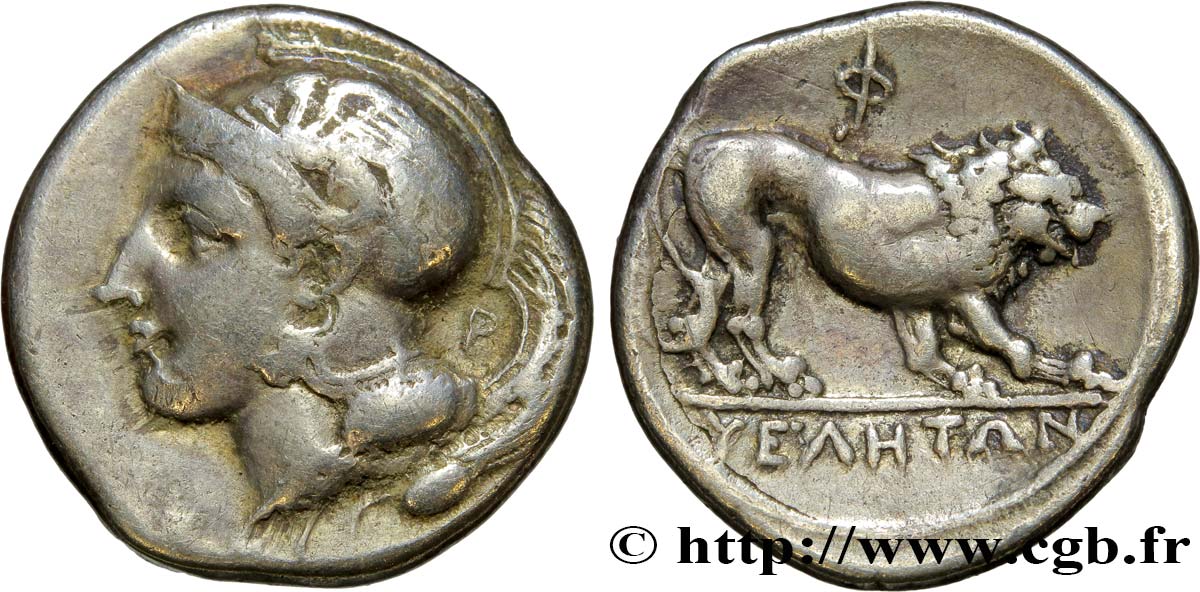
bgr_396300 - LUCANIA - VELIA Nomos, statère ou didrachme
无库存.
所有在网站上销售的产品 (2016)
价格 : 280.00 €
所有在网站上销售的产品 (2016)
价格 : 280.00 €
种类 Nomos, statère ou didrachme
日期: c. 365-350/340 AC
铸币厂名称/城市 Luncanie, Vélia
材质 silver
直径 22 mm
模子方针 6 h.
重量 7,57 g.
稀少度 R1
关于品相的说明
Exemplaire sur un flan irrégulier bien centré des deux côtés. Beau portrait d’Athéna. Revers bien à la frappe, mais un peu mou. Patine grise superficielle avec des reflets dorés
出版目录中的项代码 :
正面
正面的说明书 Tête d'Athéna à gauche, coiffée du casque attique à cimier avec triple aigrette, orné d’un griffon.
正面铭文 (RQ)
背面
背面的说明书 Lion passant à droite .
背面铭文 UELHTWN/ F
背面的翻译 (de Vélia).
评论
R. Williams a étudié la dégradation du coin de droit (A/152) et du coin de revers (R/ 203) et a déterminé six phases différentes. Très tôt, le monnayage de Vélia a été décrit comme ayant inspiré la drachme lourde de Marseille (LT. 785-791). Certains l’ont même décrit comme un monnayage symmachique : un lion de Vélia étant l’équivalent de deux lions de Marseille. Aujourd’hui, cette théorie est remise en cause, par G. Depeyrot, non sans arguments, mais avec une certaine acrimonie. Le lion de Vélia a pu servir de modèle à celui de Marseille, mais à quelle date ? La frappe à Vélia commence dans la seconde moitié du Ve siècle avant J.-C. pour se poursuivre jusqu’en 281 avant J.-C. À quel moment les Massaliotes auraient-ils emprunté le lion de Vélia ?.
R. Williams studied the degradation of the obverse die (A/152) and the reverse die (R/203) and identified six different phases. Very early on, the coinage of Velia was described as having inspired the heavy drachma of Marseille (LT. 785-791). Some have even described it as a symmachic coinage: one lion of Velia being the equivalent of two lions of Marseille. Today, this theory is challenged, not without argument, but with a certain acrimony, by G. Depeyrot. The lion of Velia could have served as a model for that of Marseille, but at what date? Minting at Velia began in the second half of the 5th century BC and continued until 281 BC. At what point could the Massaliotes have borrowed the lion of Velia?
R. Williams studied the degradation of the obverse die (A/152) and the reverse die (R/203) and identified six different phases. Very early on, the coinage of Velia was described as having inspired the heavy drachma of Marseille (LT. 785-791). Some have even described it as a symmachic coinage: one lion of Velia being the equivalent of two lions of Marseille. Today, this theory is challenged, not without argument, but with a certain acrimony, by G. Depeyrot. The lion of Velia could have served as a model for that of Marseille, but at what date? Minting at Velia began in the second half of the 5th century BC and continued until 281 BC. At what point could the Massaliotes have borrowed the lion of Velia?
历史细节
LUCANIA - VELIA
(350-281 BC)
Velia, Elea for the Greeks, was founded around 540 BC by Phocaeans who had left Asia Minor after the fall of Sardis in 546 BC. Velia became an ally of the Romans from 275 BC The lion was the symbol of the city hence its use on the coinage of Marseille because the Marseille metropolis had close ties with Velia.
 对产品描述纠错
 打印
打印 分享我的选择
 提问
提问 Consign / sell
类似物品

 产品介绍
产品介绍


Your Recently Viewed Items

50 Centimes DJIBOUTI 1919 P.23 AU
150.00 €

50 Francs MADAGASCAR 1948 P.038 UNC-
700.00 €

FRENCH POLYNESIA 2 Francs I.E.O.M. 2009 Paris MS
2.00 €

CONSEIL DU ROI Louis XIII VF
14.00 €

10 francs Conquête de l’Espace 1983 F.367/2 AU55
5.00 €

PALESTINE 50 Mils 1935 Londres AU
55.00 €
cgb.fr 集币


